Who was Fräulein Sprengel? New evidence on the origin of the Golden Dawn, or: “Vale Soror! Ave Frater!”

"Sapiens Dominabitur Astris". From 17th century emblem, by George Wither, A collection of emblemes.

In the history of the Hermetic Order of the Golden Dawn, one of the supremely most influential esoteric and magical orders in modern occultism, the question of origins has been a matter of much dispute. This is, of course, a common story for esoteric orders, or even for religious movements more broadly. If there is one thing you can count on, it’s that their founders and their followers will tend to invent mythologies, lineages, and exotic provenances to bolster their group’s sense of importance.

In the case of the Golden Dawn, founded in 1887 by a group of London based high degree Freemasons and occultists, the emic historiography has centred upon a claim to Rosicrucian lineage. The direct link was a mysterious Fräulein Sprengel of Stuttgart, also known under her magical motto Sapiens Dominabitur Astris (“the wise will rule the stars”). The evidence for this lineage was a letter communication between Sprengel and the G.D. co-founder, coroner William Wynn Westcott, which ostensibly ensued after Westcott found her address on a sheet of paper tucked together with the mysterious “cipher manuscript” on which the G.D. rituals would later be based (for the uninitiated: there’s a brief overview of the controversy around them on Wikipedia). The notorious “Sprengel letters” that ensued, and the possible background of the order have been discussed for decades by scholars such as Elic Howe and Robert A. Gilbert – the general consensus being that the letters were forged and Sprengel a fiction. In the latest issue of Aries, Christopher McIntosh publishes brand new evidence in this mystery, evidence which has been there all along but curiously overlooked by all previous investigators.

The discovery is surprising, and makes an already confusing story even more so.

(more…)

Ex-BPH books on auction in Rome

Ex-BPH incunables for sale in Rome.

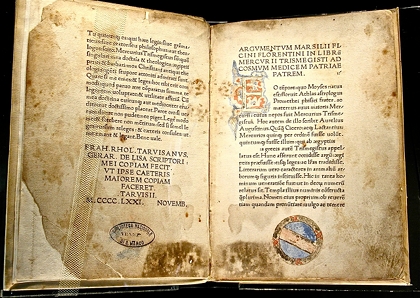
In June I wrote that some of the more expensive books and incunables that belonged to the Bibliotheca Philosophica Hermetica (Ritman Library), which was dissolved almost a year ago, surfaced at an auction in London. As Brooke Palieri at the 8vo blog noted then, the auctioned material included the 1st edition of Marsilio Ficino’s translation of Corpus Hermeticum, which used to be one of the gems of the Ritman collection. 

Now it appears that other items are very soon (October 11) to be auctioned in Rome, by Bloomsbury Auctions. The BPH items on sale seem to include later 15th century editions of the Hermetic texts, alongside first editions of Iamblichus, Plotinus (in Ficino’s translation – may go for up to € 25,000), early editions of Pico’s works, and much more. Scroll around on the page, and if you have a few (or many) thousand euros to spare this is the chance to get some rare and exotic esoteric books.

Again, this piece of news comes from Brooke Palmieri and the 8vo blog. Big thanks.

Creative Commons License
This blog post by Egil Asprem was first published on Heterodoxology. It is licensed under a Creative Commons Attribution-ShareAlike 3.0 Unported License.

Aries 11.2 – new articles and book reviews in the field of esotericism

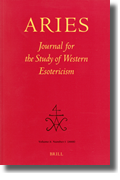
The autumn edition of Aries has just been released. This issue’s research articles deal with topics as diverse as “New Age Christianity” in Italy (Francesco Baroni), 19th century physics as context for occultism (yours truly), a report on a 15th century Christian text on magic (Damaris Gehr), and an article on Max Théon, Sri Aurobindo and “the Mother” (Peter Heehs). Perhaps the most interesting to many readers of Heterodoxology will be Christopher McIntosh’s short article, which announces a surprising discovery concerning the enigmatic “Fräulein Sprengel” and the origins of the Golden Dawn.

(more…)

… and we have a cover

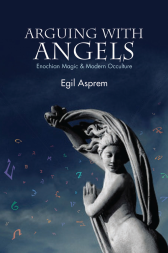
Arguing with Angels book cover

The book cover for Arguing with Angels has just been released by SUNY Press. Dark night skies with swirling Enochian letters in pastels. Too new agey, or just about enough to rise interest and curiosity? I like it, anyway.

More from the publisher here; my own first post on the book here. Comments welcome!

Published in: on September 14, 2011 at 11:11 am  Comments (4)  
Tags: ,

International Conference on Contemporary Esotericism: Call for Papers

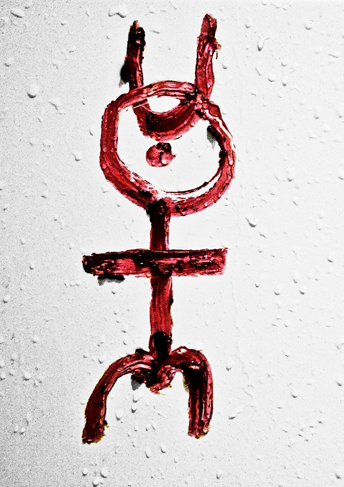
monas hieroglyphica contemporary lipstick on bathroom tilesAs advertised before, there will be a book out next year on Contemporary Esotericism, edited by Kennet Granholm and myself. The volume brings together well-established and up-and-coming scholars in the field of esotericism, with brand-new research articles on contemporary esoteric topics. In connection with the book, we are organising an international conference on the same topic, to be held at Stockholm University next August. Below you will find the full call for papers. You can also check out the conference website. It’s early, but we will accept proposals as soon as they start coming in, so no need to postpone thinking about it.

(more…)

On “Scientific Illuminism” and the Psychologisation of Magic

There is a post up at the tyromanteia blog, which offers a nice criticism of my article on Aleister Crowley’s negotiation of magic with science and psychology (“Magic Naturalized?”, published in Aries back in 2008). Tyromanteia draws on the work of Alex Owen (which I briefly reviewed last year) to place three 20th century magicians, Crowley, Israel Regardie, and Dion Fortune, within a broader “crisis of subjectivity” and a process of psychologisation. In this connection, the author finds opportunity to deal with my criticism of the “psychologisation thesis” on the survival of magic. I largely performed this criticism on the basis of Crowley, arguing that in this case, an attempted naturalisation of magic is more important than psychologisation. To this, Tyromanteia objects that Crowley largely anticipated the psychological and even psychotherapeutic interpretations which Regardie and Fortune later emphasised in their teachings. As I think this criticism points out an ambiguity in the original article, I will take this opportunity to make a brief response.

(more…)

Arguing with Angels – another book you should get next year

A bit of shameless self-promotion: A  pre-production description has recently been released by State University of New York Press, announcing the publication of my first book, Arguing with Angels: Enochian Magic and Modern Occulture. It is due in May 2012. As  SUNY’s summary states, the book is an exploration of the Elizabethan philosopher John Dee’s system of angel magic, but in particular its reception history and various reinterpretations in modern times. It follows the creation of what is usually known as “Enochian magic”. Since 19th century occultism, and continuing in 20th century and contemporary occulture, this system has been understood in a variety of ways as it has become embedded in a number of different occult currents and practices.

The book pays special attention to the discussions and quarrels among occultist groups and practitioners over the “right” interpretation, and discusses the various claims that are made to legitimise such positions – vis-a-vis competing occultist interpretations on the one hand, and  a generally perceived “disenchanted” modern society on the other. Among the main protagonists we find the Hermetic Order of the Golden Dawn, Aleister Crowley, Israel Regardie, Paul Foster Case, Anton LaVey and the Church of Satan, Michael Aquino and the Temple of Set, the obscure Order of the Cubic Stone, the Aurum Solis, and scores of cyber-age ritual magicians, debating the nature of angels and magical ritual online.

The book will appear in the SUNY series on Western Esoteric Traditions, which has previously published such classics in the field as Antoine Faivre’s Access to Western Esotericism, Joscelyn Godwin’s Theosophical Enlightenment, and Wouter Hanegraaff’s New Age Religion and Western Culture. There is no cover art up yet (this should be in place soon, my editors say), but below is the full publisher’s description:

(more…)

Terror in the Mind of Who? A response to Mark Juergensmeyer on Breivik’s Christianity (and much besides)

The question of whether or not, or in what sense, the 22/7 Oslo terrorist Anders Behring Breivik is a “Christian”, and to what extent his Christianity had anything to do with his motivations to kill, has stirred up some debate. In my first post on Breivik I referred to sociologist of religion Massimo Introvigne’s refutation of the “Christian Fundamentalist” label, a label that really makes very little sense. More recently, however, other scholars of religion have insisted on emphasising Breivik’s Christianity, although refraining from categorizing it as Fundamentalism. At the University of Chicago the well-known American historian of religion Martin E. Marty writes about Breivik the Protestant. Meanwhile, another American scholar of note, Mark Juergensmeyer, insists that we see Breivik as a “Christian terrorist”.

(more…)

Fiction, Templars, and Terrorism

Heresy Corner has a good post on the Templar theme in Anders Behring Breivik’s manifesto. It particularly discusses the author’s ambiguous claim that the whole thing is to be read as “fictional” (scare-quotes in the original). Opening the post with a quote from Umberto Eco’s Foucault’s Pendulum sets the right tone from the start:

“The lunatic is all idée fixe, and whatever he comes across confirms his lunacy. You can tell him by the liberties he takes with common sense, by his flashes of inspiration, and by the fact that sooner or later he brings up the Templars.”

(more…)

Counterjihadist Templar Terrorism? Some reflections on the terrorist from Oslo west

Prime Minister's Office, Oslo, Norway, July 22, 2011.

This is not a political blog, but sometimes something happens that gives an urgent feeling to express oneself. The horrible events in Oslo and at Utøya Friday 22 July were of this sort. I happened to have recently returned to Norway for a summer vacation, passing close by the bomb site Friday morning, then to watch the utterly absurd situation unfold on television in Trondheim that afternoon. Like the rest of the country, I have been pretty much glued to the TV screen since then. I have also spent considerable time reading the perpetrator’s 1500 page “manifesto” trying to identify, analyse and dissect motivations and ideological underpinnings, and engaging in long and sometimes heated discussions with friends about all this.

(more…)