“Alchemy: Between Science and Religion” – a workshop

On 24 June the European Society for the Study of Western Esotericism (ESSWE) will organize a one-day workshop on alchemy in Amsterdam. Some of the top experts of alchemy will present papers, including Professor Lawrence Principe of John Hopkins University. Although the main focus is on alchemy and its ambiguous relation to early modern natural philosophy and religion, the workshop is intended for graduate and postgraduate students working with themes related to esotericism more generally. Since it coincides with the board meeting of the ESSWE, virtually all the leading scholars of western esotericism will be present, including Antoine Faivre, Wouter Hanegraaff, Nicholas Goodrick-Clarke, Boaz Huss, Mark Sedgwick, and Gyorgy Szonyi. They will all happily engage in discussions with students and young researchers.

In short: A great opportunity if you’re doing an MA or PhD in this area, and can make it to Amsterdam in June. Another notable perk: It’s free. For more details, check out the announcement, which I also post in its entirety below.

(more…)

First month of heterodox blogging

It’s April, and Heterodoxology has survived its first month. The stats show ca. 1.300 hits in March, with posts dealing with magic, both old and new, as the most read. Perhaps not surprising, and I can reveal that there will, eventually, be more of that.

So far the strategy has been to write about topics that I teach, write or read about. I find that quite rewarding and will continue the policy, hopefully keeping the pace up with about two posts per week. I might also start writing somewhat shorter posts, and perhaps slicing up the larger ones into parts. We’ll see.

At any rate, the first month of Heterodoxology has been satisfying, and a thanks go out to those who have been following so far.

Published in: on April 5, 2010 at 12:01 pm  Comments (1)  
Tags: ,

Naturalistic Spiritualisms

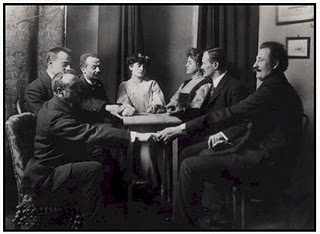
Spiritualism was a symptomatic cultural trend of the Victorian period. For decades mediums captivated the worker, the bourgeois, the nobleman, the socialist utopian, the Christian apostate, and people from virtually any and all professions, with their table rappings, levitating furniture, full-form materializations, and messages from beyond the grave. When a message was coming through, whether from the ghost of Benjamin Franklin, the archangel Gabriel, or the sitter’s aunt Nelly, the spirit medium provided the goods. But despite this caricature, which no doubt does full justice to much of the movement, spiritualism also became a heated battleground for deeply natural-philosophic questions: what is Nature, how does she operate, and what can we know about her? Where are the boundaries of the natural to be drawn?

(more…)

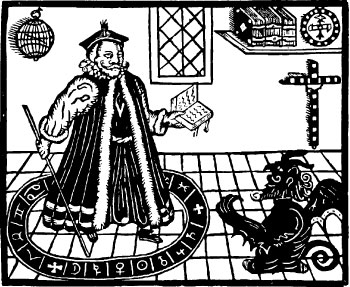
Goetia and Theurgy, magic black and white?

From Christopher Marlowe's Doctor Faustus

I was recently reminded of an article I was commissioned to write a long time ago. The topic is Goetia and modern western ritual magic. With the deadline approaching it is time to start brainstorming a bit. So be patient: rambling speech ahead!

(more…)

Magic in the desert – and more misplaced psychologisms

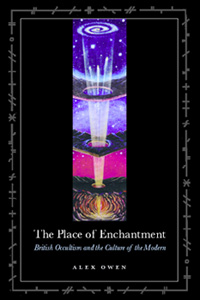
Aleister Crowley (1875-1947) is a hot name for heterodoxologists. He is also the most famous English occultist to have lived, his life having been told in about a dozen biographies. Today I taught a class on Crowley, magic, modernity and psychology, drawing on a chapter from Alex Owen’s book, The Place of Enchantment: British Occultism and the Culture of the Modern (2004).

(more…)

Published in: on March 18, 2010 at 10:36 pm  Comments (9)  
Tags: , , ,

Some notes on scientism

The word “scientism” gets tossed around a lot in critical public debates about science’s place in society. Usually it is used derogatorily to dismiss a trend in using science which the user of the word doesn’t like. Used in this way, it is a rhetorical label without much analytic content. But it may also be turned into a useful category for analyzing historical data.

(more…)

New Age televangelists?

In the very first blog post I noted in passing that contemporary media are more than happy to place a spotlight on heterodox religion and heterodox science. Well – in the latest issue of the Norwegian journal for culture- and religious studies, Din, there is an interesting article on alternative spirituality and television. Anne Kalvig focuses on the presence and function of alternative religiosity in Norwegian television media. What’s particularly interesting about it is her analysis of the sister TV channels, TV Norge and Kanal FEM as basing themselves on an “alternative-theological agenda”.

(more…)

Published in: on March 10, 2010 at 11:32 am  Comments (4)  
Tags: , ,

Galison in Utrecht

I just got home from Peter Galison’s first talk as Visiting Professor at Utrecht University. As advertised in a previous post, the lecture focused on the role of secrecy in modern science. Actually, the focus was a lot broader than that. Galison’s interest was to trace what he saw as some significant historical changes in the legitimization and enforcement of secrecy in western societies, roughly from the early 20th century until today. A significant part of his argument was that scientific discourse became subjected to secretive forms of political regulation from WWII onwards.

(more…)

Positivism and the Religion of Humanity

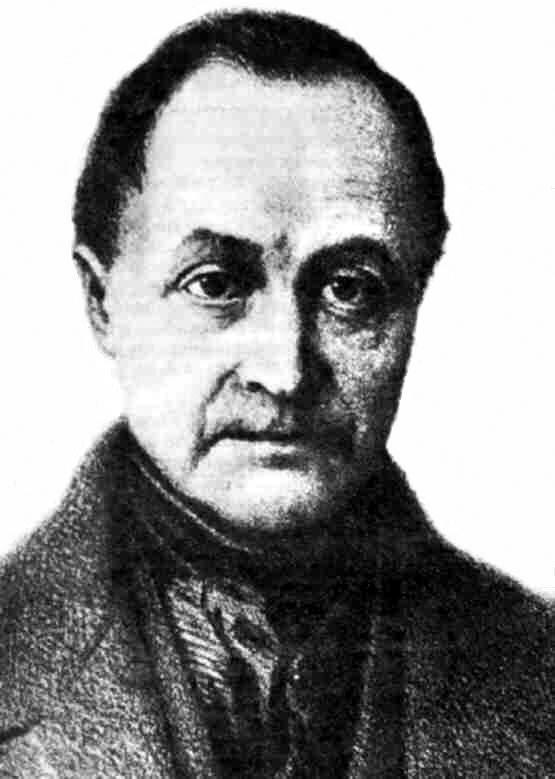
Auguste Comte (1798-1857) formulated some very influential ideas, and some ideas that were plain weird. The “father of sociology” argued for a full science of society, and invented the progressivist “Law of Three Stages”.  By the 1840s Comte had founded the highly influential philosophy and ideology of Positivism. What next? He founded a Church and proclaimed himself High Priest.

(more…)

Conference panel: Seduced by Science

This has already been disseminated through other channels, but I’ll post it here anyway. My colleague Tessel Bauduin and I are organizing a panel at the next Quinquennial World Congress of the International Association for the History of Religions (IAHR). It’s in Toronto, it’s in August, and the title of the panel is “Seduced by Science: The culture of religion and science in the early 20th century”. We’re accepting paper proposals until April 15. See below for the details.

(more…)

Published in: on March 7, 2010 at 1:32 pm  Comments (2)  
Tags: