Attendees are starting to get some distance from the ESSWE4 conference in Gothenburg now, and a number of reviews and impressions have appeared on blogs during the last week. Below you’ll find a round-up of pieces written from different perspectives. My own two cents you’ll find here.
Alchemy on the Amstel: a visit to the Ritman Library
I recently came across the great blog The Medicine Chest by historian of medicine Marieke Hendiksen at Leiden. She recently ran a review of the “Alchemy on the Amstel” exhibition that is still running at the Ritman Library (Bibliotheca Philosophica Hermetica). Worth checking out – as is the rest of the blog! (discovered via Mike Zuber’s Praeludia Microcosmica).

In September last year, I heard of the Amsterdam Ritman Library or Bibliotheca Philosophica Hermetica for the first time. I had been wanting to see the exhibition ‘Alchemy on the Amstel‘ (until 20 September 2013) ever since, and last week I finally got a chance. On a sunny afternoon I cycled to the library, hidden away in a side street of the Prinsengracht, a stone’s throw from the Westerchurch.
In stark contrast to the hustle and bustle outside, just metres away from the throngs of tourists queuing for the Anne Frank house, the Ritman Library is an oasis of silence. Founded by the Amsterdam businessman and maecenas Joost R. Ritman (1941), the library holds a unique collection of hermetic books and manuscripts with a focus on the Christian tradition. The collection covers areas as diverse as alchemy, Rosicrucian works and Gnostics, from the Middle Ages to the present…
View original post 457 more words

Announcing ContERN session at ESSWE 4 conference
The big event of the year for esotericism scholars in Europe is fast approaching: the ESSWE4 conference. During this event, there will be a special panel session on contemporary esotericism, arranged by the ContERN network. It deals with fundamental challenges for research on contemporary esotericism, and features some well-known scholars of modern and contemporary esoteric and religious movements. Read more about it at the ContERN website.

The ESSWE4 conference in Gothenburg is only a month and a half away, and judging from the conference website it is looking quite promising. As previously mentioned, there will be a ContERN panel session at the conference. We are happy to announce that a time for this event has now been confirmed: June 28, at 13.00-14.00. A full description of the panel event follows below.
ContERN Panel Discussion: Problems and Potentials in the Study of Contemporary Esotericism
(Convened and moderated by Egil Asprem & Kennet Granholm)
In 2012, the hitherto neglected study of contemporary esotericism was put firmly on the research agenda of esotericism scholars: The year saw the foundation of the Contemporary Esotericism Research Network (ContERN), the organization of the 1st International Conference on Contemporary Esotericism in Stockholm, and the publication of a major collected volume, Contemporary Esotericism (Equinox / Acumen, eds. Asprem & Granholm)…
View original post 219 more words
The new online journal Correspondences is due to release its first issue on June 1. That should be a very welcome fresh addition to the academic study of esotericism community. The journal provides a great new venue – accessible and open while retaining quality control through peer-review – and aiming to reach the new young generation of emerging scholars, as well as a broader interest community. For those who missed the first deadline, the editors now welcome submissions for the second issue, with a deadline of August 1, 2013, and a scheduled publication date of December 1. Now also accepting book reviews.
Jesus was a … shaman (heterodox Christologies II)

Jesus the shaman
Next up in what is quickly becoming a series on heterodox Christologies: Jesus was really a shaman. This claim was found in Norwegian media last week – more precisely in the Sami branch of the state channel NRK’s online news site. The (neo)shamanic healer Eirik Myrhaug went on record saying that he saw Jesus as “a great shaman”: “after all he was 40 days and 40 nights in the desert, and that’s a typical shamanic seance”.
This news item caught my attention because I have recently been working on an article on neoshamanism – or rather, on the genealogy and mythology of shamanism, as created by a motley crew of explorers, romantics, nationalists, psychedlelic gurus, anthropologists and historians since the 1600s – before it finally became a new religious movement in the 1960s. Myrhaug himself is of Sami descent, but his shamanic techniques appear to be derived from the anthropologist Michael Harner’s “core shamanism” – as is the case with the entire “revival” of shamanism in a Sami context. What struck me the most, however, was that Myrhaug’s shamanic interpretation of Jesus – which was heavily and predictably criticised by a Lutheran minister in the same news article – has a long history. “Jesus was a shaman” is in fact a stock element in the continuously expanding “universal shamanism” franchise.
Enoch/Dee debate (round-up)
Dan Harms’ review of my book led to a nice and I think quite enlightening discussion on the place of Enoch in Dee’s angel conversations, and some related questions. I was particularly pleased that Jim Davila, Professor of ancient Judaism at St. Andrew’s joined in with some details about Dee’s knowledge of Biblical sources on his PaleoJudaica blog.
I will not add anything new to the discussions at this point, but thought it could be handy for readers to have a chronologically ordered round-up of the posts and responses, which now in the end span four different blogs. So here goes:
On Enoch reception and Dee reception
There has been some debate about aspects of my book the last couple of days, following Dan Harms’ review, and my own response. Sarah Veale joined in with a post over at Invocatio, and today Dan responded once more on his blog. The debate has revolved around the Enoch figure, and the role of this figure in understanding Dee’s angel conversations. I argued that too much importance has typically been attributed to the patriarch in accounts of the angel diaries, and that the term “Enochian magic” may itself be somewhat misleading in this regard. I still stand by this claim, but I must also guard against a misunderstanding that seems to creep up.
Arguing with Angels – first chapter available for free

Arguing with Angels about to be released
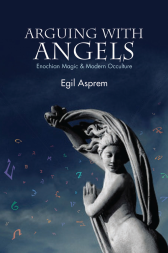
My first book, Arguing with Angels: Enochian Magic and Modern Occulture, is due to be released by SUNY Press next month (May 2012). The publisher has now released the first chapter of the book in electronic form on their website, so that you can read it there for free. This chapter is entitled “The Magus and the Seer”, and deals with John Dee’s angel conversations, the cultural and intellectual context, the role of the skryer, Edward Kelley, and some interpretations and explanations of what happened. When I wrote this chapter, already several years ago, it was intended as a “state of research” on Dee’s angelic diaries, and serve as an important reference for the rest of the book.
The book itself is not primarily about Dee and Kelley (or his other skryers), but is concerned rather with the reception history of the angel conversations in Western ritual magic. In particular, it makes a contribution to the ongoing discussion about the relation between ritual magic and modernity, about the struggle for legitimacy, about reinterpretations of magic in the face of a “disenchanted” world, and so on. It is also the first academic work to give full attention to what has come to be “Enochian” angel magic as a proper subset of occultist ritual magic, putting it properly on the map of academic scholarship.
As the publisher writes:
Science, fables and chimera
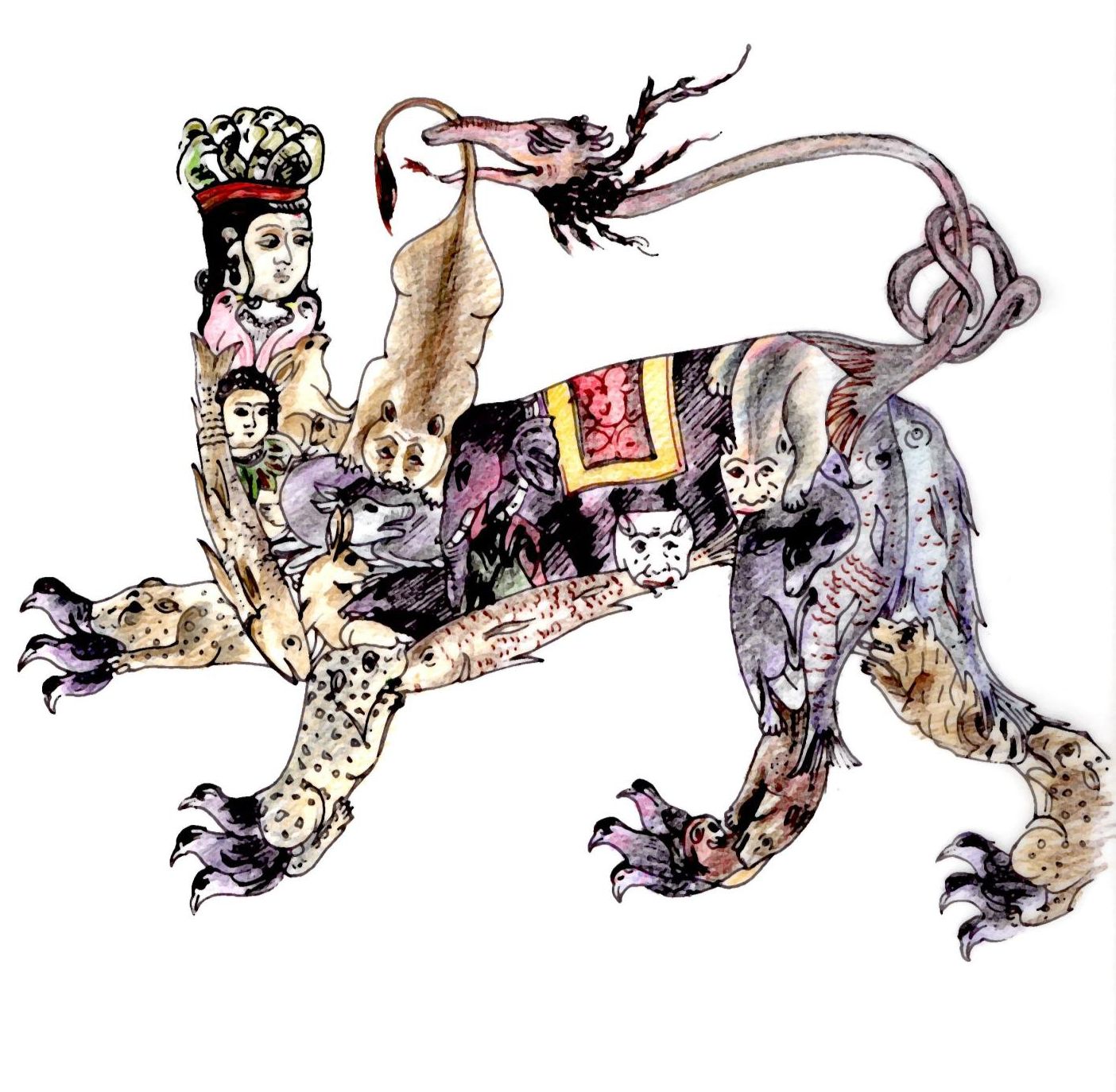 The conference season begins. My first stop this year is Toulouse, and a history of science/cultural history conference entitled “Science, fables et chimères: croissements” / “Science, fables and chimera: a strange encounter”.
A description is available from the conference website:
Aries 11.1
 Heterodoxology has aimed to establish the practice of reviewing new publications and releases in the field of esotericism, particularly notifying about current issues of the journal Aries. Aries 11.1 has been out for a couple of months already, so this comes somewhat late.





 Heterodoxology