The deadline for submitting papers to this year’s American Academy of Religion (AAR), in sunny San Diego, is fast approaching. That means time is running out if you want to present a paper on Western esotericism, too. The Western Esotericism Group of the AAR has a pretty diverse call for papers out, and entertains possibilities of several panels including collaborative ones (with e.g. the Afro-American Religious History Group and the Queer Studies group). The ESSWE, now as an associated organisation of the AAR, is also opening up for separate panels. So if you want to take part in what is going to be one of the biggest conference events for esotericism scholarship this year (besides the ASE’s biannual conference), it’s time to finish up that paper proposal! I should also add that the Esotericism Group is up for review this year, so ensuring high quality and good turnout really does matter to the future of esotericism panels at the AAR. Worth keeping in mind.
[The third and final part of my review of Otto and Stausberg’s Defining Magic. This part discusses the five final essays of the book, all of which are new contributions written by contemporary scholars of “magic”. Follow hyperlinks to read part one (focusing on the selection of texts) and part two (focusing on the editors’ introduction) of the review.]
3. Contemporary voices
That we need a systematic approach along the lines of what Stausberg and Otto suggest (or alternatively along the lines of building blocks) is confirmed by looking at the five contemporary pieces representing the current state of the debate. The five authors represent anything but a consensus. Through a broader framework of “patterns of magicity” we might nevertheless be able to put them in a fruitful dialogue.
The prize will formally be awarded at next year’s NGG meeting, which in 2014 will coincide with the big conference of the European Association for the Study of Religion (EASR) at the University of Groningen. (That conference is by the way promising to be a very exciting, as well as busy, event. Among the keynote lecturers are Bruno Latour and Carlo Ginzburg. In the shadow of such celebrity names, I’ve now been asked to put together a panel on some central concepts of my dissertation – which comes in addition to a panel session I’m already arranging together with Markus Davidsen and Carole Cusack. So lots to do.)
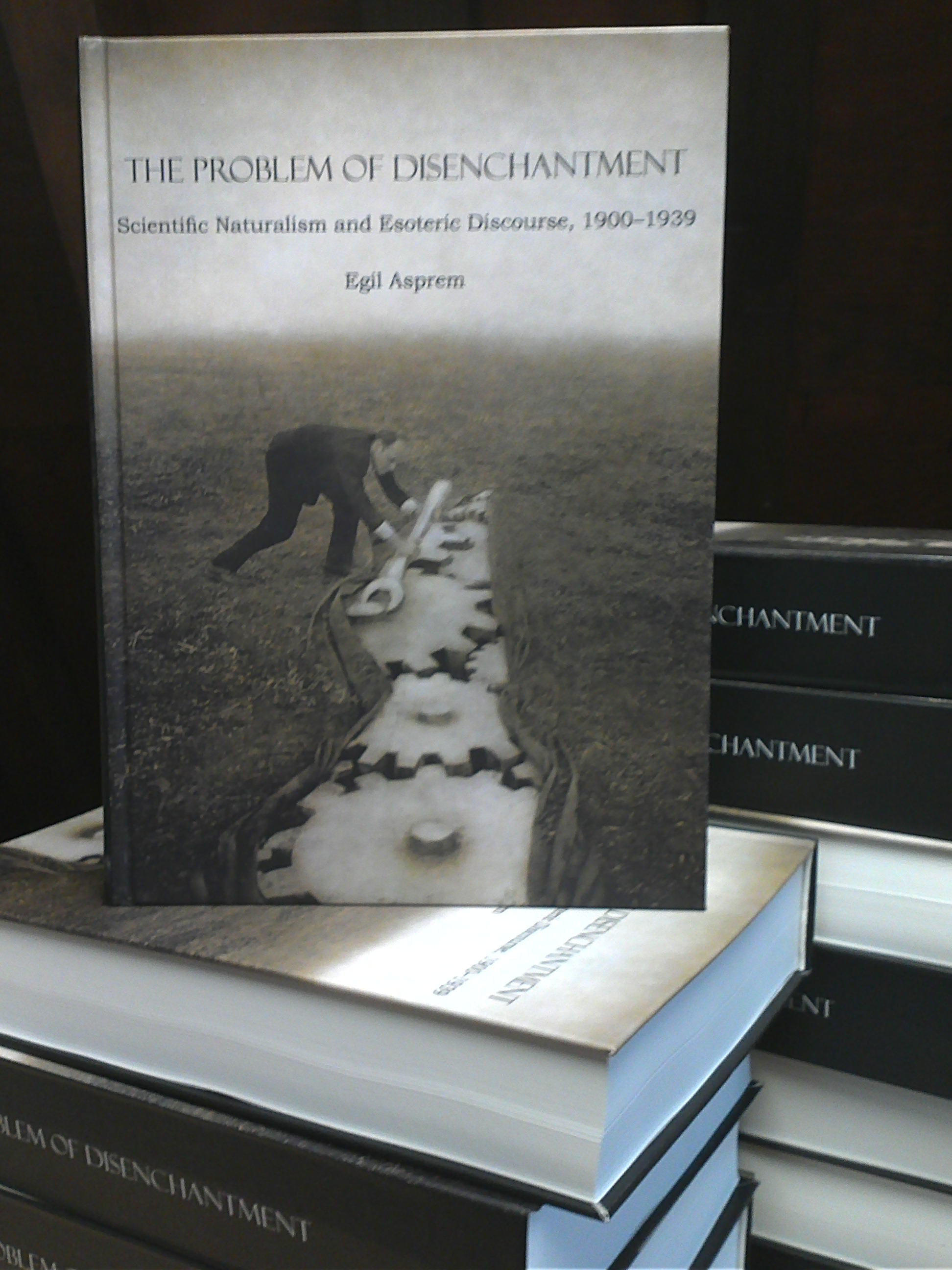
Last summer, The Problem of Disenchantment won ESSWE’s PhD Thesis Prize, making this the second award.
Back in September the call for papers for a very interesting workshop was released at the Ancient Esotericism blog (and elsewhere). “New Antiquities: Transformations of the Past in the New Age and Beyond”, put together by Almut-Barbara Renger (Freie Universität Berlin) and my good colleague Dylan Burns (Universität Leipzig), calls attention to the myriad uses and imaginings of antiquity in contemporary religious discourses. A fascinating field that has received quite some attention from religious studies scholars interested in such things as the construction of tradition or mnemohistory. What’s particularly interesting about this workshop is that it aims to mobilize the antiquity specialists as well, who, a bit too often perhaps, have tended to avoid dealing with questions related to such modern “reception history”. It’s also an excellent platform for bridging the studies of ancient and contemporary esotericism.
The deadline for submitting paper proposals has now been extended to January 31. Below follows the description of the workshop, pasted from the extension notice:
The Religious Studies Project is closing up on its second birthday. It has been a strong presence for the academic study of religion online since launching in January 2012, having released about 60 podcast interviews, numerous blog-style essays, book reviews, reports from conferences and so forth. Now the gentlemen Cotter and Robertson expand business in the direction of scholarly publishing, with the release of an online open-access research article. Knut Melvær and Michael Stausberg (both University of Bergen) have the honour of pioneering what could become a very exciting new development at RSP, with an article fittingly reporting on research into the online self-presentations of the study of religion/s.
2013 has been a very busy year on my end, characterised by several relocations, the opening and closing of projects and the managing of very different possible futures. By the end of the year I will have worked on 5-6 different contracts (depending on how you count), in three different countries. Right now I am in the middle of the final great transition of the year, which is the main reason why not much new material is turning up here these days. Let me, at least, let you in on the developments.
When Kennet Granholm and I organised the 2012 conference on Contemporary Esotericism in Stockholm, and established the ContERN website, we gave our promises that video material from the conference would appear online within a few months. I’m not sure if 14 months can be characterised as “a few”, but in any case: The first material has now been publicized. We started by releasing our own introductory lecture and welcome address. In the short lecture we discuss our reasons for establishing ContERN and organising the conference in the first place, and argue for the need of an interdisciplinary study of contemporary esotericism to take shape.
As explained on the ContERN website, the video is a lot more grainy and static than we had hoped for. We originally had two cameras, but the results from one of them unfortunately had to be discarded. Luckily, though, the audio is pretty clear, so we hope that the documentation value is still fair enough as far as the content is concerned.
Working as a historian of religion/esotericism/”pseudoscience” one often has to deconstruct misleading and sensational tabloid headlines. They could look a bit like the title of this post. Sensationalistic appeal notwithstanding, this time around I assure that the title is entirely appropriate and accurate for the topic.
There are several people that this title could have referred to – one might think of Prince Charles, or perhaps the Dutch Princess Irene, whose abilities to communicate with trees and dolphins bring her closer to the cultic fringe of the environmentalist movement. But as most Norwegian readers may have guessed, it refers to a princess closer to home.
Transhumanism and religion proves a popular topic. I started exploring some aspects of the transhumanist movement from the perspective of a scholar of religion and esotericism earlier this year, in connection with a conference. I have never had more responses from so many different audiences to a conference paper. After uploading my “Magus of Silicon Valley” paper to Academia.edu this summer, I’ve had private messages, emails, reblogs and comments (including a few annoyed transhumanist reactions) – several requests for spinoffs. First of this was a public lecture in the occulturally oriented Forum Nidarosiae in Trondheim. There’s also been interest from more old-fashioned humanists (the type that’s not too impressed by flashy prefixes such as trans-, post-, or neo-). Thus, a spin-off article is underway with the Norwegian secular humanist magazine Humanist, while another has just now been published in the Australian online magazine MercatorNet – describing itself as being of “dignitarian” orientation, which I take to be a non-confessional, non-partisan, cross-worldview form of humanism (the editor in chief, Michael Cook, is open about his Catholic leaning – while justifications appear to be classic European Enlightenment: no revelation, just reason, evidence and critical practice).
So if you haven’t read it yet, “The Magus of Silicon Valley” is now relaunched in a new medium – slightly edited and modified for the occasion (the jargon should be a little less Academese this time around). They also added a link to a very recommendable documentary on Ray Kurzweil: “Transcendent Man”. Watching it a few years back contributed to my interest in doing something on the movement from a religious studies perspective.
It’s time to sit back and await the first accusations of being in league with this or the other vested interest, dissing the transhuman visionary movement – or perhaps even supporting the coming Inquisition against it.









 Heterodoxology