Esotericism at the AAR in San Diego 2014? Urgent CfP

The deadline for submitting papers to this year’s American Academy of Religion (AAR), in sunny San Diego, is fast approaching. That means time is running out if you want to present a paper on Western esotericism, too. The Western Esotericism Group of the AAR has a pretty diverse call for papers out, and entertains possibilities of several panels including collaborative ones (with e.g. the Afro-American Religious History Group and the Queer Studies group). The ESSWE, now as an associated organisation of the AAR, is also opening up for separate panels. So if you want to take part in what is going to be one of the biggest conference events for esotericism scholarship this year (besides the ASE’s biannual conference), it’s time to finish up that paper proposal! I should also add that the Esotericism Group is up for review this year, so ensuring high quality and good turnout really does matter to the future of esotericism panels at the AAR. Worth keeping in mind.

Below is the full CfP:

(more…)

New Webinar: Marco Pasi on Gustav Meyrink & His Esoteric Novels

The latest in a long series of webinars created by the Bibliotheca Philosophica Hermetica and the Centre for History of Hermetic Philosophy and Related Currents in Amsterdam has just been released. This time Marco Pasi talks about the Austrian author Gustav Meyrink (/Meyer), arguably the most important contributor to early 20th century esoteric fiction. The relation between modern esotericism and fiction is one of Pasi’s specialties (check out his work on Fernando Pessoa), and as he tells in this webinar, he’s also been a Meyrink fan since his late teens. For a solid contextualisation of Meyrink’s work, and the influence of his work (including quite a few personal anecdotes), do check out this video.

You might also want to check out the introductory interview with Marco, introducing his new contributions to the Infinite Fire Webinar series.

http://www.youtube.com/watch?v=LYttaA3JW4Q


Esoteric summer course in Groningen, Netherlands

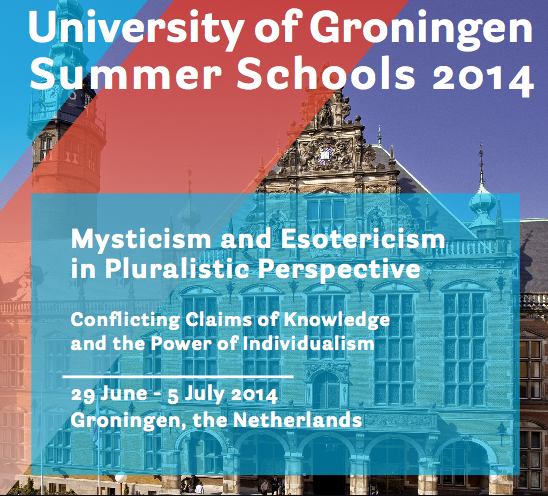
esotericism mysticism summer course University of Groningen 2014

Esoteric summer course – a unique opportunity in Groningen this summer.

For a few years now, and following the arrival of Kocku von Stuckrad at their religious studies department,  the University of Groningen in the Netherlands has offered an MA track on esotericism and related topics, called “Concealed Knowledge”. This has made Groningen one of the few places in the world where proper academic instruction in this field is available to MA and PhD-level students, alongside Amsterdam, Exeter, Rice in Houston, and the Sorbonne in Paris (by the way, the Amsterdam HHP website has a great list of these programs and related networks).

Now Groningen is making a new move, by launching a summer school program on “Mysticism and Esotericism in Pluralistic Perspective”. It is intended primarily for MA and PhD students, and will take place during an intensive week from June 29 to July 5 2014. It’s co-organized by the Universities of Groningen, Erfurt (Germany), Aarhus (Denmark), and Rice University (USA), and promises to “address fundamental questions of concepts and approaches” in the study of esotericism. Definitely worth keeping an eye out for. If you’re working on a dissertation in the field of esotericism or planning to get started on one, this seems like an important place to be.

(more…)

Patterns of Magicity: A review of Defining Magic: A Reader (eds. Otto & Stausberg; Equinox, 2013) – part 3

[The third and final part of my review of Otto and Stausberg’s Defining Magic. This part discusses the five final essays of the book, all of which are new contributions written by contemporary scholars of “magic”. Follow hyperlinks to read part one (focusing on the selection of texts) and part two (focusing on the editors’ introduction) of the review.]

Defining Magic cover Stausberg Otto

3. Contemporary voices

That we need a systematic approach along the lines of what Stausberg and Otto suggest (or alternatively along the lines of building blocks) is confirmed by looking at the five contemporary pieces representing the current state of the debate. The five authors represent anything but a consensus. Through a broader framework of “patterns of magicity” we might nevertheless be able to put them in a fruitful dialogue.

(more…)

Patterns of Magicity: A review of Defining Magic: A Reader (eds. Otto & Stausberg; Equinox, 2013) – part 2

[This is the second part of my longish review of Otto and Stausberg’s Defining Magic: A Reader. This part focuses on the introductory chapter. For part one of the review, focusing on the selection of texts, please go here.]

Magicians?

Magicians?

Patterns of Magicity: A Review of Defining Magic (part 2)

(more…)

Patterns of Magicity: A review of Defining Magic: A Reader (eds. Otto & Stausberg; Equinox, 2013) – part 1

Defining Magic cover Stausberg Otto[This blog post is a little milestone: it is the first official review of a book sent to me by the publisher for being reviewed directly at Heterodoxology. (Yes, publishers, I am open to suggestions like that!) Since the book was of great interest to me, and touches on issues that occupy me at the moment – and since the blog format allows me to say whatever I want and as much of it as I’d like – it has ended up more like a review article than a book review. Hence I will publish it here in three parts. The full pdf version (only slightly modified) is available from my Academia page. For convenience and ease of sharing. So on we go!]

Review: Bernd-Christian Otto and Michael Stausberg (eds.) Defining Magic: A Reader. Sheffield: Equinox Publishing Ltd., 2013. 281 pages.

[Part 1 of 3]

(more…)

Forbidden Histories – a blog worth following

Last autumn, Andreas Sommer defended his PhD at UCL, moved on to Cambridge  and started a blog. His PhD thesis was on the relationship between psychical research and the origins of modern psychology, a topic on which Sommer has published some very interesting articles over the last few years (recommended). The blog Forbidden Histories continues and expands these interests: if you haven’t seen it yet, it is a highly recommended history of science blog focusing on, well: “Everything you always wanted to know about science and ‘the miraculous’ (but were afraid to ask)”.

Here is how it’s introduced:

(more…)

Occultism in Global Perspective – an anthropologist’s review

9781844657162-Case.inddGordan Djurdjevic just spread a link to a review of the book he edited with Henrik Bogdan on Occultism in Global Perspective. I found it interesting enough to mention here because the review was written by anthropologist Jack David Eller in Anthropology Review Database. This is a good sign for those of us who want to see more collaboration between esotericism scholars and anthropologists. Eller clearly agrees with this from the anthropological side, concluding that:

Occultism in a Global Perspective is a book of profound significance for anthropologists, despite the fact that none of its contributors are anthropologists. Indeed, other than the Comaroff’s work on “occult economies” (which does not take ‘the occult’ particularly seriously), anthropologists have paid fairly little attention to occultism, which is strange and unfortunate. These essays illustrate that occultism is a widely practiced congeries of ideas and rituals, and occultism clearly raises issues of syncretism, globalization, and the porosity if not inadequacy of standard categories like ‘religion.’ Hopefully this collection will inspire more research and theorizing on occultism, esotericism, and such modern forms of vernacular religion, psychology, and social change.

Kennet Granholm and I made a parallel argument for our Contemporary Esotericism volume, which included a call to esotericism scholars taking anthropology more seriously.

Read the whole review of Occultism in Global Perspective here.

Looking through the Occult – talks available as podcasts

Voices through the ether

Voices through the ether

Last November I took part in an interesting interdisciplinary conference at the Humboldt in Berlin, on “Looking through the Occult: Instrumentation, Esotericism, and Epistemology“. It moved in the landscape of media studies, history of science and technology, religious studies, art history, and esotericism, and was organized by a scholarly network interested in what they call “nonhegemonic knowledge”:

(more…)

Satan in the academy (again)

I ended 2013 with a retrospective on some personal favourites from the wealth of publications on esotericism last year. Of course there were many omissions, some of which I’ve payed tribute to on Twitter. Julian Strube’s (German) book on Vril is notable, and has attracted some attention in the German press lately. Also from Germany, Monika Neugebauer-Wölk’s massive collected volume on Aufklärung und Esoterik: Wege in die Moderne is a milestone that will take time to digest and assess (I admit that I forgot about this one because the prohibitive price has made it inaccessible to me until now). Then in the antiquities section, there’s the English edition of Roelof van den Broek’s book on Gnosticism, Gnostic Religion in Antiquity. And still there’s much more that could’ve been mentioned (such as this milestone of a source work: Andrew Weeks’ new translation of Böhme’s Aurora).

(more…)