 Historian of science Andreas Sommer, who blogs at Forbidden Histories, just announced the publication of a special section on the history of psychical research and parapsychology, published in the Elsevier journal Studies in History and Philosophy of Biological and Biomedical Sciences. Usually, articles in this journal would be unavailable to most people, but this time Elsevier has provided free download links to the articles that will be accessible until December 7. Sommer has collected the links in his write-up at Forbidden Histories, along with abstracts of the articles. This means that you are just a few clicks away from finding out what role the horse Clever Hans played in the establishment of German parapsychology, how epistemically virtuous William Crookes really was, what sort of relation psychical research had to experimental physics, and what place this elusive discipline has in current historiography and philosophy of science. Among other things. Check it out.
New articles on the history of psychical research, temporarily for free download

Rosicrucian Quadricentennial: 400 years of secret brotherhoods, universal reformation, and conspiracy theories
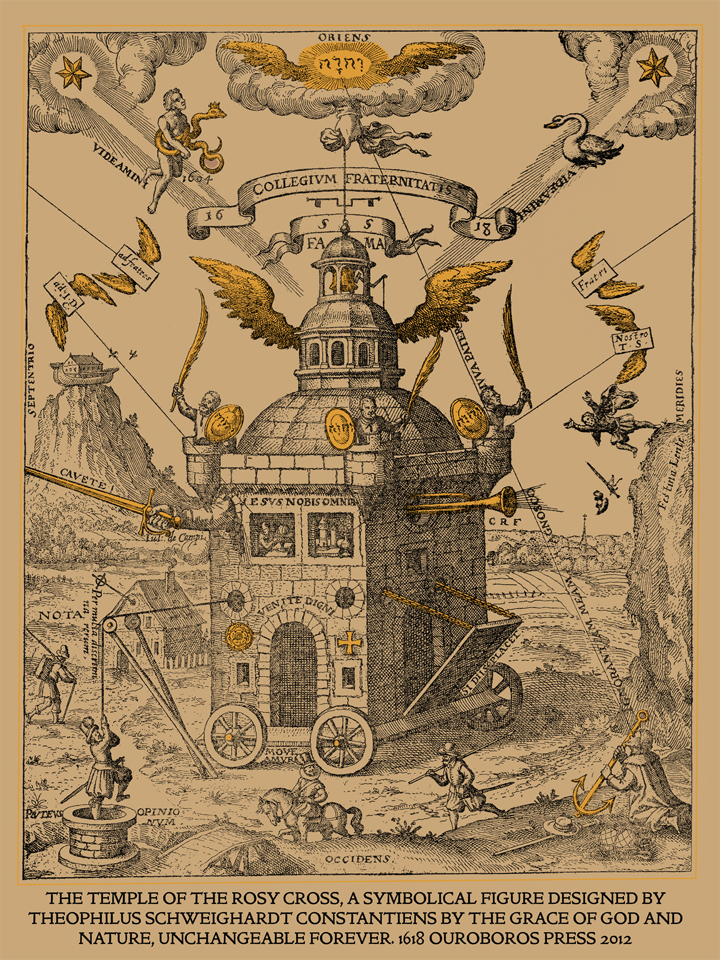
The Temple of the Rosy Cross, figure designed by Theophilus Schweighardt Constantiens (Speculum Sophicum Rhodostauroticum, 1618). This version courtesy of Ouroboros Press (2012).
This year marks the 400th anniversary of one of the most influential mythemes in the history of Western esotericism: that of the Order of the Rosicrucians. More precisely, it is now 400 years since a mysterious pamphlet entitled Fama Fraternitatis was published in Kassel. Purporting to be a communication from an unknown society founded by a medieval German monk, Christian Rosenkreutz (after travels in the Orient, of course), the Fama sparked a great furor across Europe about a powerful brotherhood working in secret to push a universal reformation of religion, science and philosophy that would usher in a new age. While the text made clear that no true Rosicrucian would ever admit to being one, the publisher immediately started receiving letters asking about where to sign up. True to their word, however, the real Rosicrucians failed to step up. But by the end of the century, people started forming their own Rosicrucian Orders, and the story of the secret society was stepping out of the realm of fiction and into the realm of fact. By now such societies are counted by the dozens. (At least – I haven’t actually counted them, but be my guest!)
Launching “Occult Minds”: official website of my postdoctoral research project

Occult Minds: New website on esotericism and cognition
It has been more than six months since I left Amsterdam for California, and some have maybe been wondering what I’m up to. To finally prove that I’m not just surfing all day, here, at long last, is the website of my postdoctoral research project, Occult Minds. The website contains quite a bit of information already, about the project itself and some of the directions it is taking. It also includes a blog, where I will be posting updates on the project as well as reviews and reflections on relevant studies. The first post contains some reflections on a book with a title very close to my project: Christopher Lehrich’s The Occult Mind: Magic in Theory and Practice (Cornell UP, 2007). With a music metaphor, it is a form of counterpoint to what I am aiming to do: there are harmonies between the two, but the rhythms and structures of the individual melodies are so different they could belong to separate musical genres.
“Materialization: Occult Research on the Soul” – an esoteric lecture with Andreas Kilcher at UCSB
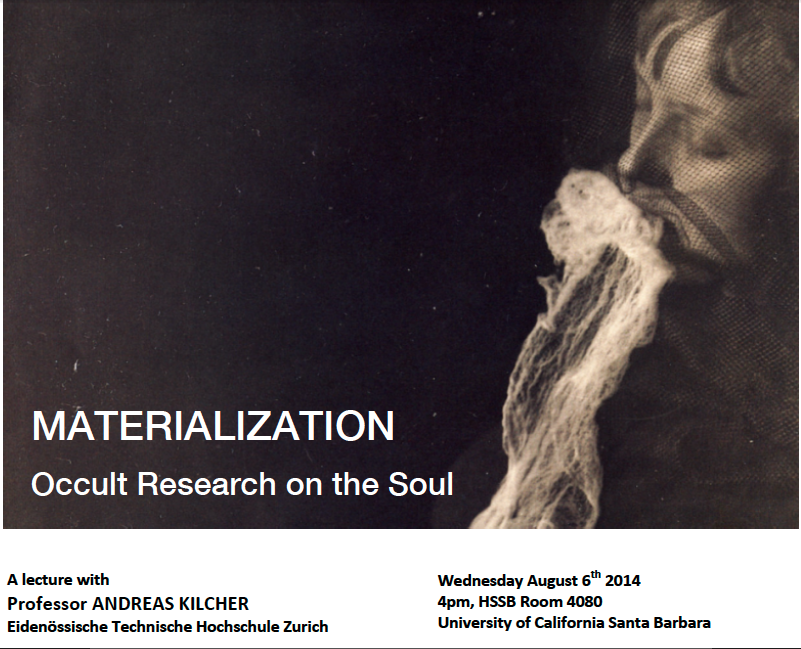
This summer, the President of ESSWE, Andreas Kilcher, has been located at Stanford University. With me being based at UC Santa Barbara, we found a great opportunity to arrange a small esotericism event at the UCSB Religious Studies Department and the Religion, Experience and Mind Lab group that I am working with. So if you are in the area, consider this event on August 6th: Andreas Kilcher lectures on “Materialization: Occult Research on the Soul”. Scroll down for the abstract (or download the flyer here):
New Antiquities – conference review at Albion Calling
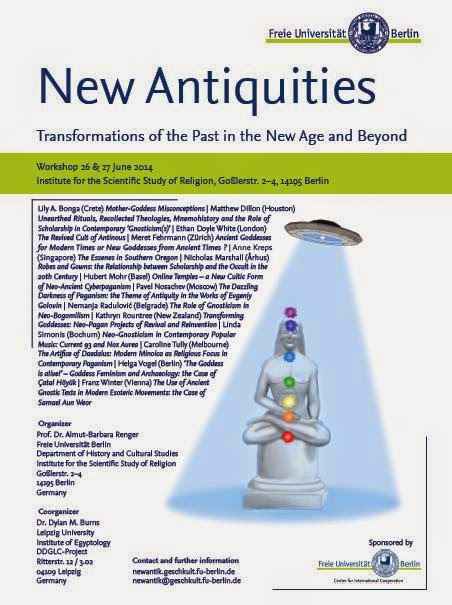 There was a conference in Berlin last month that I would have loved to visit: New Antiquities: Transformations of the Past in the New Age and Beyond. This event conceived by Dr. Dylan Burns and Dr. Almut-Barbara Renger is on a topic that I think deserves a lot more attention than it’s being awarded: the diverse uses of the historical past to construct new forms of practice, tradition, aesthetic and worldviews.
Well, we know a great deal already about the invention of tradition, of course. What would be really cool is to get archaeologists, classicists, historians, philologists and other experts of “what really happened” (or the best current approximations, anyway) to talk with those who study the imagined past (what’s sometimes called “mnemohistory” – the history of how the past is remembered). Something along those lines is what this conference aimed to do. One of the reasons why the task is crucial is that, unavoidably, the access that those who construct the past have to the past, goes eventually through scholarship – often, to be sure, outdated scholarship, and often, too, scholarship that has been filtered through other channels such as popular culture – or the less than reliable akashic records. Getting experts of the contemporary and the ancient to talk together thus seems a mutually enriching opportunity, especially for theorizing the role of scholars in the discursive production of the past and of invented traditions.
For those of us who missed that opportunity this time, there is a nice little review of the conference over at Albion Calling. Ethan Doyle White gives a good summary of the speakers and the topics they treated, with a specific focus on issues relating to contemporary paganism. Go read it.
Books from the Esoteric Brat Pack
As a member of what’s been called the “brat pack” of esotericism scholars I am proud to note that a considerable number of us are appearing on the scene this year with monographs based on PhD dissertations. The brat pack presumably consists of a group of (then) students and emerging scholars who were around at the time of ESSWE 1 in 2007, and who have frequently been seen together at conferences since. While some of us have teamed up for joint gigs in the past (think The Devil’s Party or Contemporary Esotericism, and the conferences that went with both of these), it looks like 2014 is the big year for solo work. I know of at least four titles either published or forthcoming in 2014 by (for the most part) recent PhDs working in the field of Western esotericism. There may be other publication plans I am not aware of (please leave a note!). Here’s a chronological list of the knowns.
The end of EXESESO
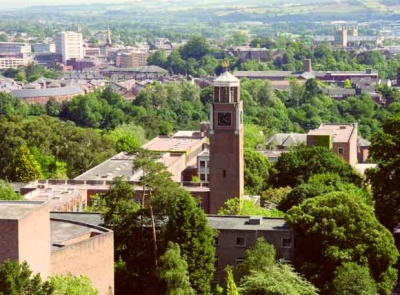
University of Exeter, former home to the Exeter Centre for the Study of Esotericism (EXESESO)
After the untimely death of Nicholas Goodrick-Clarke back in 2012 (see obituary in The Times, and by Christopher McIntosh in Aries [pay-wall]) , there has been much speculation about what would happen with the Exeter Centre for the Study of Esotericism (EXESESO) that he ran at the University of Exeter. Since 2005, EXESESO has offered one of the three official university programs for the academic study of esotericism in Europe (the others being in Amsterdam and Paris), and produced a steady stream of MAs through its distance learning program. After an internal evaluation process at Exeter University, in dialogue with the Theosophically oriented Blavatsky Trust who funded the centre, a final decision has now been made to shut EXESESO down. Mark Sedgwick reports on the decision in the Spring 2014 ESSWE newsletter, which was released today:
ASE in progress, next stop Budapest – Esotericism conference update
The Fifth International Conference of the Association for the Study of Esotericism (ASE – the American older sister of ESSWE) is happening at Colgate University (Hamilton, NY) these days, with an interesting lineup and topic. It’s not the only esotericism event to take place this summer, however: As previously noted here there is a new regional network of ESSWE around – CEENASWE, focusing on central and eastern Europe – and they are holding their launching event in Budapest on July 4-5. The program is quite impressive for such a young network, including speakers from Poland, Hungary, Serbia, Israel, the Netherlands, the US, etc., giving papers on topics ranging from neopaganism in Serbia to Hungarian Freemasonry, from early-modern Christian Kabbalah to modern occultism, from literary expressions and visual art to neo-Gnosticism in modern Orthodox contexts. Much to look forward to.
And all the papers are in English, which gives a unique opportunity for international exchanges on these topics and sets a new precedence for work in this area in the years to come. It is really encouraging to see that solid scholarship on esotericism is not only expanding geographically, but that we’re also seeing new opportunities for integrating this work with the broader international community. It promises a healthy counterweight to a predominantly anglophone, French- and German-dominated field.
ESSWE PhD Thesis Prize 2015 – Submissions welcome!
A call has just gone out for nominating PhD dissertations for next year’s biannual ESSWE Thesis Prize. So if you are finishing a dissertation on an esotericism related topic, it’s time to slip this call to your supervisor and subtly suggest a nomination. The reward? Honour and glory and € 500 prize money, awarded at next year’s ESSWE Conference in Riga, Latvia. There will be some money available for reimbursing travel expenses to Latvia. The awarded dissertation will be recommended for publication in the Aries Book Series. More information on who can apply, when, to whom, and so forth, see the call – which I also paste below.
Theosophical Appropriations – videos from a workshop
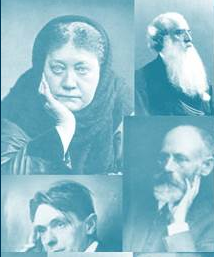
INASWE workshop on Theosophy, kabbalah, Western esotericism, and appropriations of traditions
The INASWE [Israeli Network for the Academic Study of Western Esotericism] has done it again. Videos from a workshop held last December on the theme of “Theosophical Appropriations: Kabbalah, Western Esotericism, and the Transformation of Traditions” are now online, and they show an impressive number of great scholars talking about intriguing aspects of modern esotericism, angled through the Theosophical current one way or another. The conveners Julie Chajes and Boaz Huss have done a great job putting together this group. One of the nice aspects of this collection is the global scope, giving a panoramic view of Theosophical groups across a number of different countries.
As in previous years, it is wonderful that all of this is made available online. So go and watch Karl Baier talk about how the chakras were introduced into Theosophy, John Patrick Deveney lecture on Theosophy as Lesenmysterium, Moshe Idel pontificate on Theosophy and Kabbalah in Romania, Massimo Introvigne entertain on the topic of Canadian Theosophy, and let Marco Pasi enlighten you on the role of the Theosophical movement in Italian esoteric milieus. And much, much more.




 Heterodoxology