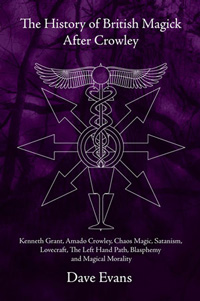
 Although Aleister Crowley has become the icon of modern ritual magic and occultism, magic did not end with his death in 1947. While approximately a dozen books have been devoted to Crowley, surprisingly little has been written about his legacy in contemporary occultism. His impact on later currents such as contemporary witchcraft, Satanism, and various pagan groups has often been mentioned, but vast areas still remain uncharted, from Chaos Magic and cyber paganism to the recent history of the Ordo Templi Orientis, the Golden Dawn, and Crowley’s A\A\. The result is that a relatively broad range of contemporary western esotericism remains essentially unstudied. Below follows my review of Dave Evans’ contribution to this field of study, recently published in Aries 10.2. Hyperlinked for the occasion.
British magic after Crowley: review

IAHR: Two panels
 As mentioned a couple of times before, I am going to Toronto next weekend to join the IAHR World Congress. It only happens every five years, and is a big happening in the fields of religious studies/Religionswissenschaft. This year there will also be a considerable presence of esotericism research. Marco Pasi, Cathy Gutierrez and Allison Coudert are hosting a large panel on “Western esotericism and its boundaries”, which, by systematically tackling the issue of the cultural and geographical boundaries of this concept will no doubt be an important occasion for this field of research. In addition there is the “Seduced by Science” panel, which I co-host with Tessel M. Bauduin. For anybody who’s interested, I attach more details about these two panels below.
Breaking the silence – and some news
Summer time has been upon me and Heterodoxology has been dead silent for a while. Unfortunately, when I look at the pile of things to do these coming months I fear it may stay that way. This is nevertheless an honest attempt at getting things rolling again. I’ll just kick off with some whimsically chosen (perhaps relevant) news:
Searching for pictures of Comte on the internet again, are we?
 Today this blog has existed for four months. It has grown steadily since the first post, with a marked increase in June.
One of the interesting things with writing about relatively separate things – from Mesmerism to 19th century scientism to eugenics in Norway to lectures on alchemy to Goetic ritual magic – is keeping a track on what’s being read, and from where. In the beginning I wasn’t very surprised to find that ritual magic, and things to do with Aleister Crowley tended to generate more hits.
I was a bit more surprised when the short piece on Comte’s religion of humanity started to sprint away from the other posts. It is currently the most visited one – and that with almost five times as many hits as #2.
Variations on “Auguste Comte” are the three most used search words to find Heterodoxology. Further down the list we find phrases such as “fotos de auguste comte”, “pictures of auguste comte”, and “imagenes de comte”. My humour has always tended towards the silly, but I find it a little amusing.
But my favorite searches are still “how to become possessed by demons”, and “are there any real angelic languages?” I am afraid whoever came for answers to those must have navigated away rather disappointed.
Lux in Tenebris: Call for papers for the 3rd international congress of the ESSWE

The Visual and the Symbolic in Western Esotericism
The call for papers is out for next year’s biannual conference of the ESSWE. This is the third one: after Tübingen in 2007 and Strasbourg 2009, the 2011 conference will be held in Szeged, Hungary, on 6-10 July. The title is “Lux in Tenebris: The Visual and the Symbolic in Western Esotericism”, and should open for some interesting cross-disciplinary perspectives (art history, film studies, literary studies, cultural analysis?) on esoteric discourse, from late antiquity to contemporary times. (Also, the program includes a visit to the catacombs of the Buda castle in Budapest – wouldn’t miss it!) Deadline for proposals is November 15, 2010. I attach the full call for papers below.
Plato the Pythagorean – a possible revolution in Plato research?

I must admit to feeling a sceptical gut reaction when I first read about J. B. Kennedy’s brand new article on Pythagorean number theories being embedded in the structure of Plato’s dialogues – a possible key to his unwritten doctrine. I first read about it in The Guardian‘s rather popularizing account. After doing some more searches, and finally checking the original paper published in Apeiron, I am happy to say it looks much more solid than one first expects when hearing something along the lines of “lone scholar x cracking codes in the works of legendary intellectual hero y“.
Neurosurgical nonsense and the historical method
The brain of God, or just another Rorschach effect?
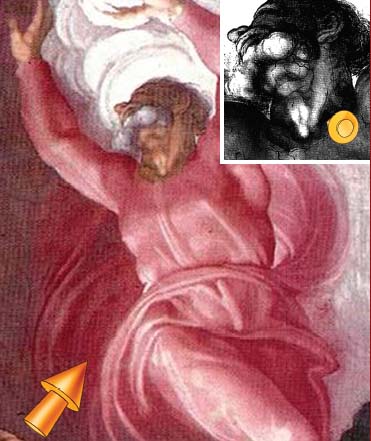
Some will have noticed the recent revival of speculation about the anatomical knowledge of Michelangelo. The blog at Scientific American reported on “findings” published in Neurosurgery this May. The authors, Tamago and Suk, claimed to reveal detailed anatomical sketches of a human brain and nervous system hidden in the “Separation of Light and Darkness” fresco in the Sixtine Chapel.
Rather exceptional, since these anatomical details were officially not known until 360 years later. The cutting-age anatomy of the day was that of Vesalius – very impressive, but hardly taught to modern-day neurosurgeons.
This unfortunate piece of Scientific American-backed high-publicity nonsense has been thoroughly debunked by Darin over at PACH (here, here, and here). In addition to clarifying some of the serious historical errors of fact in the SA piece, he has some very readable reflections on the utter disregard for the historical method, and the typical fallacies encountered (a little too often) when scientists try their hands at history of science. Go read it. (The PACH blog will now duly be added to the blog roll).
Alchemy, and how to write about it: ESSWE thesis workshop
 As advertised before on this blog, the European Society for the Study of Western Esotericism (ESSWE) has been organising a thesis workshop on alchemy. It took place in Amsterdam on June 24; here is a short report.
More on Goetic Magic: Three 20th century developments
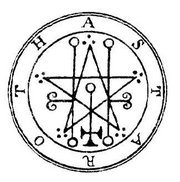 In a previous post, now a couple of months ago, I wrote about the distinction between goetia and theurgy in ceremonial magic. I tried to trace the development of the distinction, in very broad strokes, from neo-platonic discussions in late antiquity through the renaissance rehabilitation of magic, through to 19th century occultism. This was part of developing my thoughts for an article on «Goetia in Modern Western Magic», the deadline for which has now (as it usually goes with academic anthologies) been postponed. This gives me opportunity to try out some more ideas here.
Lawrence Principe and the Rehabilitation of Alchemy – another lecture in Utrecht
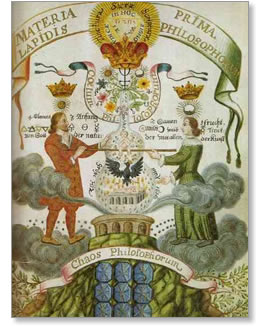 Utrecht has apparently become the place for me to see visiting historians of science. A couple months back Peter Galison gave lectures and a workshop on secrecy and science, and now last week, the alchemy specialist Lawrence Principe gave the third Descartes-Huygens lecture on “Uncovering the Secrets of Alchemy and its Role in the History of Science”. It was quite a ceremonial occasion, as Principe, who is ordinarily based at John Hopkins University, was officially given an honorary fellowship at Utrecht Unversity. As the man himself opened by saying, this was probably the first time since the 17th century that the oration of a new fellow would be devoted to the art of alchemy.




 Heterodoxology