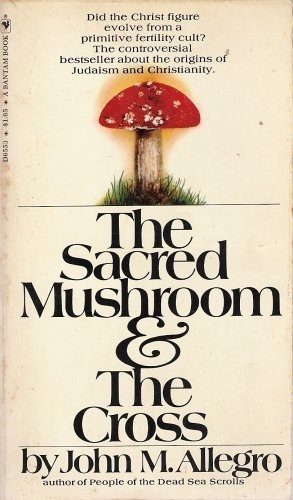
“Jesus was a mushroom” – Interview with John Allegro

In the last post I mentioned that Creative Reading has a post up on the biblical scholar John M. Allegro, who committed academic suicide in 1970 when he published a book arguing that Christianity had been a fertility cult with the  ingestion of psilocybin hallucinogenic mushrooms (fly agaric) as its central rite – the true “body of Christ”, as it were. That post has now been updated with a link to an interview with Allegro, conducted by two Dutch comedians for their satirical show, “Het Simplistisch Verbond” (the Simplistic Alliance), in 1976.

As Wouter points out in his blog post, the intention with the interview was no doubt to poke fun at what to any regular viewer comes across as a hilariously insane theory. Allegro swallows the bait whole and swims away with it. The interview is an intriguing insight into the scale of Allegro’s  theory of religion in general: religion has its origin in solar-phallic worship and entheogenic practices. An educational video for one of the theories of religion that is generally not taught in religious studies programmes. Perhaps for good reason. Watch it and find out why Jesus was a mushroom.

News in the Blogroll

I don’t often make structural changes and clean-ups at Heterodoxology. One of the results is that the blogroll is not always up to date. I won’t claim that it is now either, but at least I have made an attempt to update it ever so slightly. You will now find a basic classification of blog categories (not quite happy with it, but it’ll have to do for now): history of science, religious studies, esoterica/pagan, skeptical, and academic miscellany.

(more…)

Coptic scholars are in a strange position compared to most other researchers of arcane and obscure corners of history: their field occasionally makes world-wide news headlines, especially when there is some text claiming something about a certain carpenter from Nazareth. Last week newspapers across the world announced that someone writing in  coptic on a piece of papyrus some time possibly in the 4th century had insinuated that the carpenter might have had a wife. Sensational, but well: it turns out the papyrus fragment is most likely not authentic. Read more about the arguments in this excellent post by Hugo Lundhaug and Alin Suciu. (For the record – this is the first time I reblog anything, so bear with me).

Alin Suciu's avatarAlin Suciu

First of all, it should be clearly stated that, although in the following lines we shall express our doubts concerning the authenticity of the so-called Gospel of Jesus’s Wife, our suggestions remain hypothetical until the ink of the document has been properly tested. Secondly, our analysis does not refer either to the figure of the historical Jesus, or to his marital status, which are beyond our field of expertise, but only to a literary fragment written in Coptic, whose identity is suspicious.

During the 10th International Congress of Coptic Studies, which took place September 17-22, 2012 in Rome, the Harvard Professor Karen L. King introduced to us a previously unknown Coptic papyrus fragment.

(SOURCE OF THE PHOTOGRAPH)

Her paper was delivered on Tuesday, September 18, from 7.00 o’clock P.M., in one of the rooms of the Patristic Institute ‘Augustinianum.’  We estimate that about…

View original post 1,476 more words

Launching ContERN with a Google group and a Call for Papers

As announced previously, a new network has been created with the aim of placing the field of contemporary esotericism clearly on the agenda of academic research: the Contemporary Esotericism Research Network, or ContERN for short (no connection with the Third International, we promise…). It is affiliated with the European Society for the Study of Western Esotericism (ESSWE), and everyone who participate in our activities is encouraged to become a member of that organisation (which can be done by applying online here).

There is currently a Google group which will work as a mailing list and discussion forum for the network (click here to sign up), and also a Facebook group for easy communication.

As the description on the Google group reads:

(more…)

Contemporary Esotericism round-up and other news

It’s been a long time away from blogging, but for good reason I assure you. While in the middle of moving house I have been finishing  my dissertation, a good 600+ pages that will be sent off to committee members on Friday. Now  more work awaits in  following up on a recent event in Stockholm: as announced many times on this blog, the 1st International Conference on Contemporary Esotericism was held at Stockholm University on August 27-29.

(more…)

Hermetically Open – BPH 2.0

The Ritman library has risen from the ashes of the calamity of 2010. The new developments look very promising and should interest many international readers – particularly because of the initiative “Hermetically Opened”. With it, the Bibliotheca Philosophica Hermetica is being proactive about joining the digital and connected age. It’s the next best thing to having the  unique library of hermetic, alchemical, and rosicrucian literature in your own living room. Digitization projects are underway,  there are plans for a Hermetic wiki, and not least, great plans for a webinar series where scholars of esotericism and Hermeticism will speak about particular topics. All of this is available to a global public online, and you can read all about it at the  library’s new website.

The webinar series, named “Infinite Fire”, was officially launched last week, with a short talk by my colleague Dr. Peter Forshaw, a specialist in the history of alchemy. Future talks are being planned, to begin with by other experts present in Amsterdam (Wouter Hanegraaff and Marco Pasi). The idea is, however, to expand with time. So if you are a scholar working in an area related to the library’s collection, and you’re planning a trip to Amsterdam, I am sure that the BPH staff would love to hear from you. Perhaps you will do a brief interview or otherwise contribute to this collaborative, evolving “global hermetic circle”?

Peter talks about / devours some of his favourite books from the BPH collection below:

Very promising developments indeed. Do check it out.

Contemporary Esotericism conference drawing close – full programme ready

The 1st International Conference on Contemporary Esotericism is drawing close. Kennet and I have been working hard the past two weeks on putting together a program schedule, editing the book of abstracts and collating other  useful information. Those who are already registered for the conference will already have received the schedule by email. Now it is also available online at the conference website. Better yet, the complete book of abstracts can be found as a pdf here. I add a copy of the schedule below as well. If you want to find more about a particular paper, you can go to the book of abstract. And of course: If this looks tempting, you are still welcome to join the conference! Registration is open continuously online.

(more…)

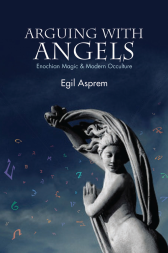
Enoch/Dee debate (round-up)

Dan Harms’ review of my book led to a nice and I think quite enlightening discussion on the place of Enoch in Dee’s angel conversations, and some related questions. I was particularly pleased that Jim Davila, Professor of ancient Judaism at St. Andrew’s joined in with some details about Dee’s knowledge of Biblical sources on his PaleoJudaica blog.

I will not add anything new to the discussions at this point, but thought it could be handy for readers to have a chronologically ordered round-up of the posts and responses, which now in the end span four different blogs. So here goes:

(more…)

On Enoch reception and Dee reception

There has been some debate about aspects of my book the last couple of days, following Dan Harms’ review, and my own response. Sarah Veale joined in with a post over at Invocatio, and today Dan responded once more on his blog. The debate has revolved around the Enoch figure, and the role of this figure in understanding Dee’s angel conversations. I argued that too much importance has typically been attributed to the patriarch in accounts of the angel diaries, and that the term “Enochian magic” may itself be somewhat misleading in this regard. I still stand by this claim, but I must also guard against a misunderstanding that seems to creep up.

(more…)

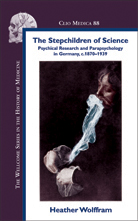
Parapsychology in Germany – review of Heather Wolffram’s Stepchildren of Science (2009)

In 2009 a fat and promising book landed on my desk, fresh from the publisher. I had looked forward to it for a while, as the topic was highly relevant for my dissertation, and this was the first full-length academic study ever to look at it. It was furthermore written by an author whose articles on the same topic I had been following for a while, with great interest. The book was Heather Wolffram’s Stepchildren of Science: Psychical Research and Parapsychology in Germany, c. 1870-1939. I was going to write a book review for Aries, which I did. It only appeared this spring, however. Since it is already three years ago that the book was published, I think it is about time to share the review with a broader community. So please find the pre-publication version of the review below.

(more…)