 I have been meaning to post on an excellent new initiative that kicked off in January: The Religious Studies Project (RSP). It is rapidly becoming the best (and only?) webportal for the academic study of religion in Europe, sponsored by the British Association for the Study of Religion. (The Americans have things like Religion Dispatches, and a good number of related blogs – including by the legendary Peter Berger). I’ll let RSP introduce themselves:
The Religious Studies Project – and a podcast on fiction-based religion

European Identity Politics and the Memory of Paganism – a conference panel in Amsterdam, 20 April 2012
 Last December I was approached by Markha Valenta, a colleague in the history department of the UvA and an occasional contributor to the OpenDemocracy project, asking if I wanted to organize a panel for the upcoming international conference on “Regimes of Religious Pluralism in 20th-Century Europe”. The invitation was inspired by some of the things I wrote on this blog concerning Behring Breivik and religion last summer, and my role would be to compose a “heterodox” component for the conference. I said yes, and started contacting some people. Now, one month before the conference starts, we have three speakers and a juicy topic: “European Identity Politics and the Memory of Paganism”. Below follows a description of the panel’s theme, and a list of speakers and titles.
Science and religion for lunch? Illustre School lecture, 12 April 2012

Lecture at Spui25, Amsterdam
I have been invited to give a public lecture in the Illustre School’s lunch lecture series, “Geesteswetenschappen presenteert” (“The Humanities present…”). The topic is nothing less than “The relationship between science and religion”, which I will of course set forth in a final and authoritative manner in the exactly 18 minutes that I am given… So if you want a heavy lunch on April 12, please do come to Spui25 in the centre of Amsterdam. Seats are limited, so you need to register at Spui25’s website if you want to come (please note that registration only opens one month in advance of the lecture).
The full program can be found here, but the abstract reads as follows:
Esoteric news, January 2012
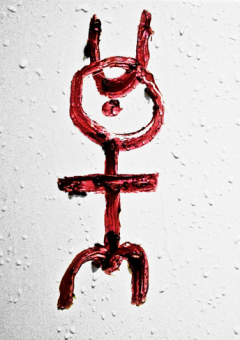
Among the updates: 1st International Conference on Contemporary Esotericism
A number of newsworthy things have popped up in the world of esotericism scholarship lately, but as I have been tied up with reaching deadlines, they have not found their way to Heterodoxology yet. The solution? A brief list of updates, below. Some of it you may already have read about over at Invocatio, the Phoenix Rising website, or some other etheric place, but no harm is done in hearing something twice.
Terror in the Mind of Who? A response to Mark Juergensmeyer on Breivik’s Christianity (and much besides)
The question of whether or not, or in what sense, the 22/7 Oslo terrorist Anders Behring Breivik is a “Christian”, and to what extent his Christianity had anything to do with his motivations to kill, has stirred up some debate. In my first post on Breivik I referred to sociologist of religion Massimo Introvigne’s refutation of the “Christian Fundamentalist” label, a label that really makes very little sense. More recently, however, other scholars of religion have insisted on emphasising Breivik’s Christianity, although refraining from categorizing it as Fundamentalism. At the University of Chicago the well-known American historian of religion Martin E. Marty writes about Breivik the Protestant. Meanwhile, another American scholar of note, Mark Juergensmeyer, insists that we see Breivik as a “Christian terrorist”.
Counterjihadist Templar Terrorism? Some reflections on the terrorist from Oslo west
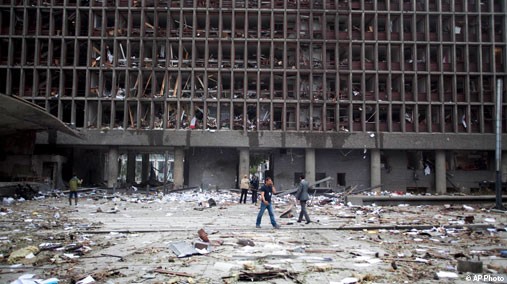
Prime Minister's Office, Oslo, Norway, July 22, 2011.
This is not a political blog, but sometimes something happens that gives an urgent feeling to express oneself. The horrible events in Oslo and at Utøya Friday 22 July were of this sort. I happened to have recently returned to Norway for a summer vacation, passing close by the bomb site Friday morning, then to watch the utterly absurd situation unfold on television in Trondheim that afternoon. Like the rest of the country, I have been pretty much glued to the TV screen since then. I have also spent considerable time reading the perpetrator’s 1500 page “manifesto” trying to identify, analyse and dissect motivations and ideological underpinnings, and engaging in long and sometimes heated discussions with friends about all this.
News in the blog roll
When I got around to buy the heterodoxology.com domain earlier this year, the idea was to start some renovations of the site. Now, finally, one small step: updating the blog roll. Some inactive old blogs have been removed, and a few new, heterodoxologically relevant ones have been added.
First, the additions: Invocatio is a fairly frequently updated and well informed blog (mostly) about Western esotericism. It is run by Sarah Veale in Toronto, and well worth checking out, among other things for its weekly “Myseria Misc. Maxima” installments. Religion Dispatches is perhaps the leading blog/online magazine for research on religion and contemporary debates about religion, and should have been added long ago. To keep up to date on what happens in the modern pagan communities as well as the occulture surrounding it, Jason Pritzl-Waters’ The Wild Hunt is a must-read. For all lovers of dusty old books I have added the bibliophile blog 8vO. Finally, to satisfy a twin appetite for science fiction and historiography, Mark Novak’s wonderful Paleofuture blog is now available in the blog roll. It is a great resource for exploring the history of futures past.
Out goes a few blogs that have become inactive (Grimoires, Heteropraxis, Knokkelklang, Dodologist, SNASWE Blog), or turned out to be heterodoxologically less relevant (The Necromancer). More additions are likely to follow.
 This blog post by Egil Asprem was first published on Heterodoxology. It is licensed under a Creative Commons Attribution-ShareAlike 3.0 Unported License.
Blind Spots of Disenchantment (1/3)
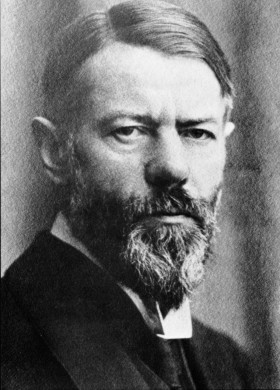
Max Weber (1864-1920)
The way things have turned out, the content of my PhD dissertation will revolve around a concept which Max Weber somewhat unsystematically formulated almost 100 years ago: the disenchantment of the world. Disenchantment has usually been described as a socio-cultural process, driven by rationalisation and intellectualisation processes which Weber traced back to the invention of monotheism, and the development of monotheistic theology. It has been embraced by sociologists and historians of religion in particular, who have seen in it (as did Weber) certain consequences for the condition of religion, magic, and their relation to intellectual life (and particularly science) in the modern world. My dissertation is increasingly becoming a criticism of the concept of disenchantment, and an exploration of a more nuanced approach to it as it relates to interfaces between religion, science, and that vast unsystematic and poorly defined set of “the occult”, “esoteric”, and “magical”. In April I had two opportunities to discuss these ideas in workshop settings, first with a commentary from the social historian of knowledge Peter Burke, and later in a research workshop for cultural history PhDs in the Netherlands called the Barchem symposium. In this post, and in two following installments, I will share the text of my lecture(s), intended to give an overview of my general approach, illustrated with snapshots of relevant cases from early 20th century history of science and culture. This first post discusses, historicises and criticises Weber’s concept of disenchantment in what is a brief theoretical introduction proposing that we take a different approach to it. Part two will concern the place of this revised notion in early 20th century scientific discourses, particularly in their broader cultural reception and context. The third part discusses briefly the attempt to create a “new natural theology” in this period.
Contemporary Esotericism – a pre-production advertisement
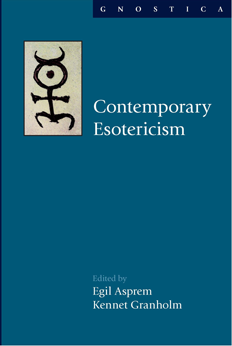 One of the reasons for not writing here very often this spring is that I am co-editing a major volume in my “spare time”. Last week I visited my good friend, colleague and co-editor Kennet Granholm at Stockholm University, to discuss some final issues. This weekend, we ship the manuscript off to Equinox Publishing – a full 689 pages – ending a period with much editorial work. To celebrate this, I’ll kick off some pre-production advertising of the volume, which bears the title Contemporary Esotericism.
Quantitative heterodoxology
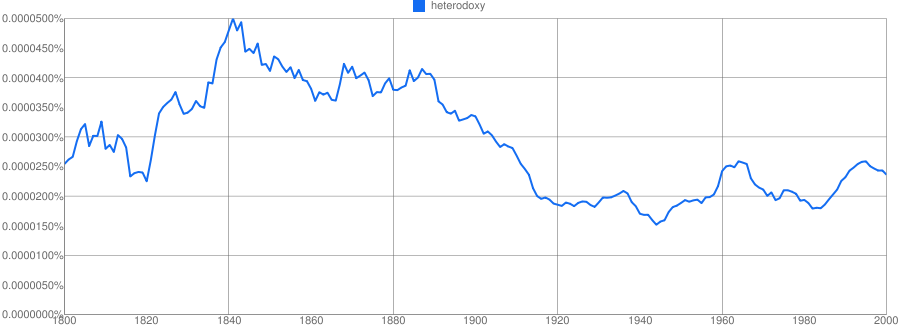 Last week Science published an article introducing the term “culturomics” – the quantitative study of cultural trends. By constructing a database out of the by now 15 million books that Google have digitized over the past years, a Harvard based research team led by Jean-Baptiste Michel have created a powerful searchable tool which makes it possible to create quantitative date for analysing cultural trends. As they state in the abstract:
We constructed a corpus of digitized texts containing about 4% of all books ever printed. Analysis of this corpus enables us to investigate cultural trends quantitatively. We survey the vast terrain of ‘culturomics,’ focusing on linguistic and cultural phenomena that were reflected in the English language between 1800 and 2000. We show how this approach can provide insights about fields as diverse as lexicography, the evolution of grammar, collective memory, the adoption of technology, the pursuit of fame, censorship, and historical epidemiology. Culturomics extends the boundaries of rigorous quantitative inquiry to a wide array of new phenomena spanning the social sciences and the humanities.
In short, this is a tool which has the potential to revolutionise research methods in a vast number of fields. The best part: Google Labs have made the tool (the Ngram viewer) publicly available. Before even starting reading the article I found myself thinking about a number of applications for my own research and field. Below follow some rough examples, and preliminary results which already seem to challenge established knowledge in the history of esotericism.




 Heterodoxology