“Materialization: Occult Research on the Soul” – an esoteric lecture with Andreas Kilcher at UCSB

Kilcher lecture

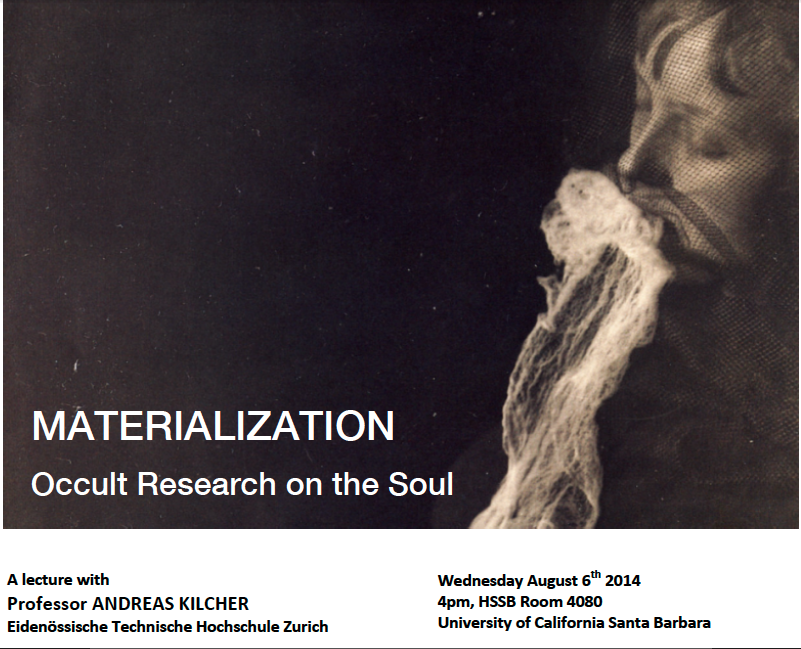
This summer, the President of ESSWE, Andreas Kilcher, has been located at Stanford University. With me being based at UC Santa Barbara, we found a great opportunity to arrange a small esotericism event at the UCSB Religious Studies Department and the Religion, Experience and Mind Lab group that I am working with. So if you are in the area, consider this event on August 6th: Andreas Kilcher lectures on “Materialization: Occult Research on the Soul”. Scroll down for the abstract (or download the flyer here):

(more…)

New Antiquities – conference review at Albion Calling

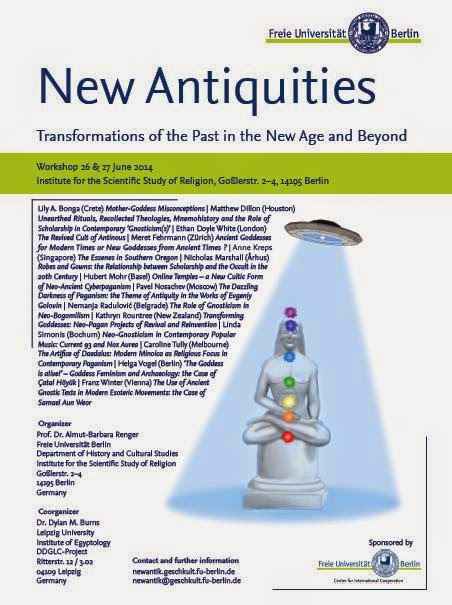
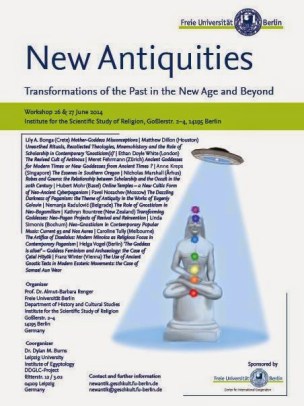
New AntiquitiesThere was a conference in Berlin last month that I would have loved to visit: New Antiquities: Transformations of the Past in the New Age and Beyond. This event conceived by Dr. Dylan Burns and Dr. Almut-Barbara Renger is on a topic that I think deserves a lot more attention than it’s being awarded: the diverse uses of the historical past to construct new forms of practice, tradition, aesthetic and worldviews.

Well, we know a great deal already about the invention of tradition, of course. What would be really cool is to get archaeologists, classicists, historians, philologists and other experts of “what really happened” (or the best current approximations, anyway) to talk with those who study the imagined past (what’s sometimes called “mnemohistory” – the history of how the past is remembered). Something along those lines is what this conference aimed to do. One of the reasons why the task is crucial is that, unavoidably, the access that those who construct the past have to the past, goes eventually through scholarship – often, to be sure, outdated scholarship, and often, too, scholarship that has been filtered through other channels such as popular culture – or the less than reliable akashic records. Getting experts of the contemporary and the ancient to talk together thus seems a mutually enriching opportunity, especially for theorizing the role of scholars in the discursive production of the past and of invented traditions.

For those of us who missed that opportunity this time, there is a nice little review of the conference over at Albion Calling. Ethan Doyle White gives a good summary of the speakers and the topics they treated, with a specific focus on issues relating to contemporary paganism. Go read it.
The Problem of Disenchantment: Now published

The Problem of Disenchantment - Coming to a university library near you.

The Problem of Disenchantment – Coming to a university library near you.

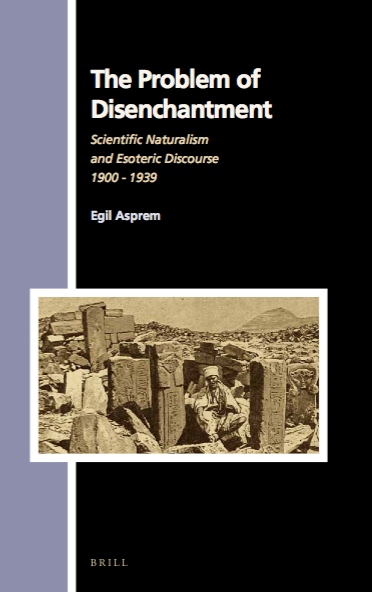
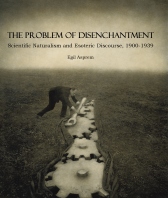
I received exciting news this morning that my second book The Problem of Disenchantment: Scientific Naturalism and Esoteric Discourse, 1900-1939 is now officially published and available from Brill. Based on my PhD research it’s been a long time in the making (about 6 years), so it will be very satisfying to see the final hardbound result (waiting for my author copies). Time to request review copies and tell your local university library to stock it! Of course, you should do that with the other publications from the esoterica “brat pack” as well.

For a teaser of my book, here are three flattering blurbs from three exceptional scholars:

This is a path-breaking book! It not only opens up an interdisciplinary space in which to analyze a range of responses to disenchantment within and between the history of religion, the history of science, and the history of esotericism, but it articulates a method – Problemgeschichte – for doing so. The method allows Asprem to surface many contending views on the place of mysterious incalculable powers in the modern world, which cut across disciplines in surprising ways, and to demonstrate the value of a critical constructivism build on naturalistic grounds for scholarly work.

Ann Taves, University of California at Santa Barbara.

The complex interface between the sciences, religion, and esoteric forms of thought and experience is one of those “elephants in the living room” that many know about but almost no one knows how to talk about. Egil Asprem knows how to talk about it, and very well indeed: through a historical genealogy of the interface, through a careful tracing of the debates around the limits of reason and science, and through an astute rethinking of Weber’s seminal notion of disenchantment. The result is extremely satisfying and rich beyond measure.

Jeffrey J. Kripal, author of Authors of the Impossible: The Paranormal and the Sacred.

Egil Asprem’s study has the potential of causing a Copernican revolution in our understanding of the “disenchantment of the world”. Grounded in meticulous textual analysis of a large sample of representative sources – from the “hard” natural sciences via psychical research to the “soft” domain of religion and esotericism – it combines sensitive historical research with sharp theoretical reflection and should lead us to question some of our most deeply ingrained assumptions about the nature of modernity.

Wouter J. Hanegraaff, University of Amsterdam.

Their words, not mine.


Published in: on July 17, 2014 at 9:27 pm  Comments (1)  

Books from the Esoteric Brat Pack

As a member of what’s been called the “brat pack” of esotericism scholars I am proud to note that a considerable number of us are appearing on the scene this year with monographs based on PhD dissertations. The brat pack presumably consists of a group of (then) students and emerging scholars who were around at the time of ESSWE 1 in 2007, and who have frequently been seen together at conferences since. While some of us have teamed up for joint gigs in the past (think The Devil’s Party or Contemporary Esotericism, and the conferences that went with both of these),  it looks like 2014 is the big year for solo work. I know of at least four titles either published or forthcoming in 2014 by (for the most part) recent PhDs working in the field of Western esotericism. There may be other publication plans I am not aware of (please leave a note!). Here’s a chronological list of the knowns.

(more…)