After the untimely death of Nicholas Goodrick-Clarke back in 2012 (see obituary in The Times, and by Christopher McIntosh in Aries [pay-wall]) , there has been much speculation about what would happen with the Exeter Centre for the Study of Esotericism (EXESESO) that he ran at the University of Exeter. Since 2005, EXESESO has offered one of the three official university programs for the academic study of esotericism in Europe (the others being in Amsterdam and Paris), and produced a steady stream of MAs through its distance learning program. After an internal evaluation process at Exeter University, in dialogue with the Theosophically oriented Blavatsky Trust who funded the centre, a final decision has now been made to shut EXESESO down. Mark Sedgwick reports on the decision in the Spring 2014 ESSWE newsletter, which was released today:
ASE in progress, next stop Budapest – Esotericism conference update
The Fifth International Conference of the Association for the Study of Esotericism (ASE – the American older sister of ESSWE) is happening at Colgate University (Hamilton, NY) these days, with an interesting lineup and topic. It’s not the only esotericism event to take place this summer, however: As previously noted here there is a new regional network of ESSWE around – CEENASWE, focusing on central and eastern Europe – and they are holding their launching event in Budapest on July 4-5. The program is quite impressive for such a young network, including speakers from Poland, Hungary, Serbia, Israel, the Netherlands, the US, etc., giving papers on topics ranging from neopaganism in Serbia to Hungarian Freemasonry, from early-modern Christian Kabbalah to modern occultism, from literary expressions and visual art to neo-Gnosticism in modern Orthodox contexts. Much to look forward to.
And all the papers are in English, which gives a unique opportunity for international exchanges on these topics and sets a new precedence for work in this area in the years to come. It is really encouraging to see that solid scholarship on esotericism is not only expanding geographically, but that we’re also seeing new opportunities for integrating this work with the broader international community. It promises a healthy counterweight to a predominantly anglophone, French- and German-dominated field.
ESSWE PhD Thesis Prize 2015 – Submissions welcome!
A call has just gone out for nominating PhD dissertations for next year’s biannual ESSWE Thesis Prize. So if you are finishing a dissertation on an esotericism related topic, it’s time to slip this call to your supervisor and subtly suggest a nomination. The reward? Honour and glory and € 500 prize money, awarded at next year’s ESSWE Conference in Riga, Latvia. There will be some money available for reimbursing travel expenses to Latvia. The awarded dissertation will be recommended for publication in the Aries Book Series. More information on who can apply, when, to whom, and so forth, see the call – which I also paste below.
Comparison and the Study of Esotericism
A few weeks ago, Correspondences 2.1 appeared, featuring my article “Beyond the West: Towards a New Comparativism in the Study of Esotericism”. I focus on the role of comparative methods in the field of esotericism, a subject that has been fraught with controversy due to excessive misuses of such methods in the past. The core of my argument is that we need to lift the more general ban on comparativism that has largely been in effect, and start developing new and responsible ways of opening up the field to both cross-cultural and other sorts of comparative research. I analyse the scholarly background, the current situation, and offer concrete suggestions – including a typology of different sorts of comparative research that might be undertaken, and for what reasons.
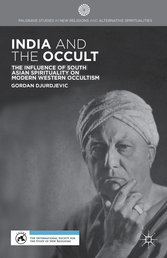
The reason for writing this post is not just to pique your interest in this article, however, but rather to point out that there is a broader discussion mounting at the moment. In religious studies generally, the debate is opened up again now with Jeffrey Kripal’s recent text book, Comparing Religions (Wiley, 2013), and in my article I cite a growing literature in esotericism studies that move in this direction. It was however nice to receive another addition in the mail last week, Gordan Djurdjevic’s India and the Occult: The Influence of South Asian Spirituality on Modern Western Occultism (Palgrave, 2014). Leafing through it this afternoon inspired this post, because I realize that Djurdjevic makes a sort of contribution that should have been included in my discussion had it been available half a year ago. So here are some quick thoughts, relating our comparativist projects.