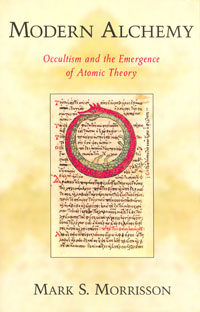
Review: Mark Morrisson’s “Modern Alchemy”

(The following is my review of Mark Morrisson’s Modern Alchemy. The final version was published in Aries 11.1).

In 1901 physicist Ernest Rutherford and chemist Frederick Soddy, tucked away in a laboratory at McGill University, Montreal, Canada, were struck with amazement as they watched the element thorium transform into an inert gas. Soddy, exclaiming that they had witnessed nothing less than transmutation, was warned by his more temperate colleague: “For Mike’s sake, Soddy, don’t call it transmutation. They’ll have our heads off as alchemists”.

Alchemy would, however, be invoked frequently during the decades to come; not with reference to obscure occultists in the secret vaults of hermetic societies, but in connection to new discoveries concerning radioactive decay. Indeed, in its the early decades, what would become nuclear physics was commonly labelled “modern alchemy”. The crucible and athanor had been replaced by cloud chambers, spectroscopes, and ionization chambers,  but there was a nagging feeling that the ancient and modern alchemists ultimately shared the same goal: the transmutation of elements.

(more…)

ESSWE3 coming up

The third biannual international conference of the European Society for the Study of Western Esotericism (ESSWE) is fast approaching. As previously announced, “ESSWE3” will be held in Szeged, Hungary, on July 6-10. A detailed program of the conference, listing speakers, paper titles, place and time, etc., has recently been published by the conference organizers. Check it out.
(more…)

Buying back the Corpus Hermeticum?

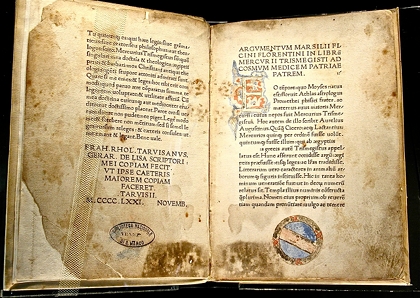
Corpus Hermeticum first edition, previoulsy in the Bibliotheca Philosophica Hermetica, seen for sale in London. (Picture is of another copy).

As previously announced, much of Mr. Ritman’s collection of hermetica and rosicruciana is returning to Amsterdam. After settling some of the debt with Friesland Bank, everything except the ca. 300 most valuable items were returned to the collector of what used to be the Bibliotheca Philosophica Hermetica.

Yesterday, Brooke S. Palmieri at the bibliophile blog 8vo  reported to have seen several of the BPH incunables at the Olympia Book Fair in London, where they were on display at the stand of Shapero Rare Books. According to Palmieri, among the books displayed was the previously mentioned gem of the BPH, Ficino’s 1471 first edition of (the Latin translation of) the Corpus Hermeticum. I have not been able to find the book in Shapero’s online catalog, and do not know whether any of the old BPH books were traded during the fair. Any news on this would be much appreciated.

Read the story at 8vo.


Creative Commons License
This blog post by Egil Asprem was first published on Heterodoxology. It is licensed under a Creative Commons Attribution-ShareAlike 3.0 Unported License.

Science, fables and chimera

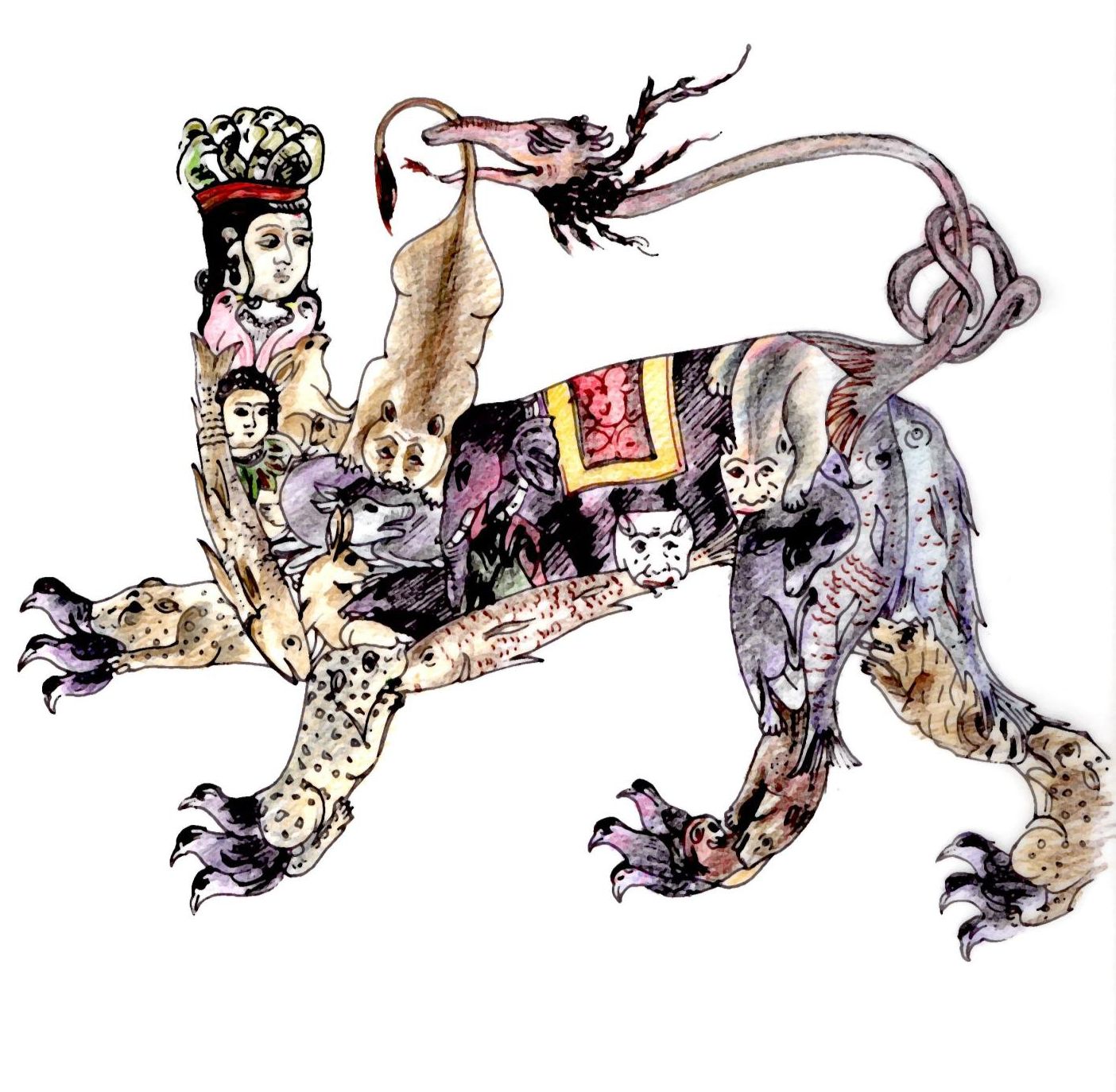
The conference season begins. My first stop this year is Toulouse, and a history of science/cultural history conference entitled “Science, fables et chimères: croissements” / “Science, fables and chimera: a strange encounter”.

A description is available from the conference website:

(more…)

Published in: on June 9, 2011 at 6:07 am  Leave a Comment  
Tags: ,

New hope for the Ritman Library?

This morning the Dutch newspaper Trouw brought some promising news about the Bibliotheca Philosophica Hermetica, or Ritman Library, which was closed last November. Due to a large  debt and an ensuing conflict between Mr. Joost Ritman, Friesland Bank, and the Dutch State, the collection was dissolved at the end of last year, with one part going to the National Library in the Hague, and another confiscated by the bank.

(more…)

More lectures available from the INASWE inaugural conference

As mentioned recently, the new local network of the ESSWE in Israel recently held their inaugural conference. I already posted Wouter Hanegraaff’s inaugural lecture on Jung and the Eranos circle; however, the conference organizers have taken care to record and make available seven other lectures as well. Most deal with Kabbalah, both Jewish and Christian, as one would perhaps expect given the location and special local competence. The lectures by Isaac Lubelsky and Boaz Huss both discuss Zionism, and esoteric aspects and contexts of Zionist thought and ideology. There is also a sort of introductory lecture on Traditionalism by the specialist of that politicized esoteric current, Mark Sedgwick. If all that is not juicy enough, Julie Chajes’ lecture promises nothing less than a peak into Christian Zionist Sexual Mysticism (the latter, I should add, in a Victorian context). You’ll find them all below.

(more…)

INASWE launched with lecture on Jung and Eranos

The European Society for the Study of Western Esotericism (ESSWE) is expanding. The society was established in 2005. Since then it has encouraged the establishment of regional subgroups, to promote research and teaching about esotericism on the local level and on independent initiatives. In 2007 the first such local initiative  was established in the Scandinavian countries (SNASWE). Since last year scholars at the Ben Gurion University of the Negev in Israel, largely on the initiative of  Professor Boaz Huss, have worked to establish an Israeli Network for the Study of Western Esotericism (INASWE).

(more…)

Aries 11.1

Heterodoxology has aimed to establish the practice of reviewing new publications and releases in the field of esotericism, particularly notifying about current issues of the journal Aries. Aries 11.1 has been out for a couple of months already, so this comes somewhat late.

(more…)

Blind Spots of Disenchantment (3/3)

The third and last part of my paper on the “Blind Spots of Disenchantment” focuses on the somewhat neglected concept of Weber’s 1918 “Wissenschaft als Beruf” paper: “the intellectual sacrifice”. It looks particularly at the Scottish Gifford Lectures’ attempt to promote a new “natural theology”, and suggests that this whole attempt defies Weber’s emphasis that science and religion are being/ought to be kept apart in a disenchanted modern world. It also includes the complete bibliography for all three parts.

(more…)