Ethan Doyle White has been running a nice interview series at his blog Albion Calling for a while. Among others he ran interviews with both of the two scholar-practitioners of western ritual magic who suddenly passed away earlier this year, Dave Evans and Nevill Drury. I’ve been meaning to add this blog on pagan studies, esotericism, archaeology etc. to the blog roll for a while (it needs serious update). Now that Ethan has published this interview with yours truly I should probably hurry up. Check it out.
“Occulture is Ordinary” – Chris Partridge’s keynote lecture, ContERN conference, 2012
The first full keynote lecture from ContERN 2012: Christopher Partridge on why occulture is ordinary. I’ll especially recommend the interesting discussion at the end. Some brilliant and sharp questions to the occulture theory, which perhaps should be explored further.

Continuing our series of posts from last year’s conference on Contemporary Esotericism, today we have released the video of Christopher Partridge’s keynote lecture, “Occulture is Ordinary”. Please do check it out (on site and the YouTube channel) – and don’t miss the discussion with the audience towards the end!
(For clarification: the respondents we hear at the end are Christian Greer (University of Amsterdam), Per Faxneld (Stockholm University) and Bernd-Christian Otto (Universität Erfuhrt).

Conference on “Esoteric Practices” – ASE call for papers
This call for papers for the next ASE conference (Association for the Study of Esotericism) has already circulated for a while, but since the deadline is still two months away (January 15 to be exact) it can still be circulated some more. The ASE is the American sister organization of the ESSWE, and the idea has been that these two societies will offer their biannual conferences in alternating years. Thus, we had ESSWE4 in Gothenburg in 2013, and will get ASE5 at Colgate University, Hamilton NY in 2014.
The topic that ASE has chosen for next year’s conference is I think an excellent one: “Esoteric Practices: Theories, Representations and Methods”. It’s an excellent idea because, quite surprisingly, there has been very little research on practice in this field. This is largely due to a bias towards “ideas” and “systems of thought” and historical genealogies, and a lacking engagement with social scientific research communities (anthropologists and ethnographers above all). That does not mean that no such research exists – it does, and especially outside of the context of “esotericism scholarship” as institutionalised in the family of journals, book series and scholarly societies that identify as such. But conceptualisations of “esotericism” (whether as a theoretical object or a historical phenomenon) have not sufficiently looked at the practical dimension or engaged the research that already exists. There are notable exceptions, of course, but not many.
Looking through the Occult: Conference on Instrumentation, Esotericism and Epistemology in the 19th Century (Humboldt U, Berlin)
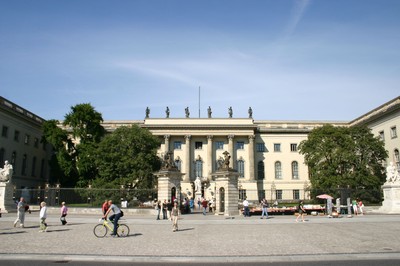
Humboldt University at Unter den Linden 6, Berlin.
I’m excited to participate in a wonderful conference at Berlin’s Humboldt University on November 14-15: “Looking through the Occult: Instrumentation, Esotericism and Epistemology in the 19th Century”. The conference is free and open to the public, so if you are in Berlin and have an above average interest in topics such as spiritualism and mediums, ether physics, spirit photography, early radio technology and x-rays, this should be a good treat. Check out the nice website for more information on the programme, how to get there, and what to read up on in advance.
ContERN YouTube channel and lectures from 2012 conference
When Kennet Granholm and I organised the 2012 conference on Contemporary Esotericism in Stockholm, and established the ContERN website, we gave our promises that video material from the conference would appear online within a few months. I’m not sure if 14 months can be characterised as “a few”, but in any case: The first material has now been publicized. We started by releasing our own introductory lecture and welcome address. In the short lecture we discuss our reasons for establishing ContERN and organising the conference in the first place, and argue for the need of an interdisciplinary study of contemporary esotericism to take shape.
As explained on the ContERN website, the video is a lot more grainy and static than we had hoped for. We originally had two cameras, but the results from one of them unfortunately had to be discarded. Luckily, though, the audio is pretty clear, so we hope that the documentation value is still fair enough as far as the content is concerned.
Make sure to check it out if you’ve been curious what was said during the conference – and stay tuned for the keynote lectures, which will be released in the coming weeks! Also make sure to subscribe to the ContERN YouTube channel.
A cult leader in the (royal) family
 Working as a historian of religion/esotericism/”pseudoscience” one often has to deconstruct misleading and sensational tabloid headlines. They could look a bit like the title of this post. Sensationalistic appeal notwithstanding, this time around I assure that the title is entirely appropriate and accurate for the topic.
There are several people that this title could have referred to – one might think of Prince Charles, or perhaps the Dutch Princess Irene, whose abilities to communicate with trees and dolphins bring her closer to the cultic fringe of the environmentalist movement. But as most Norwegian readers may have guessed, it refers to a princess closer to home.
The Magus of Silicon Valley – multiple afterlives of a conference paper
Transhumanism and religion proves a popular topic. I started exploring some aspects of the transhumanist movement from the perspective of a scholar of religion and esotericism earlier this year, in connection with a conference. I have never had more responses from so many different audiences to a conference paper. After uploading my “Magus of Silicon Valley” paper to Academia.edu this summer, I’ve had private messages, emails, reblogs and comments (including a few annoyed transhumanist reactions) – several requests for spinoffs. First of this was a public lecture in the occulturally oriented Forum Nidarosiae in Trondheim. There’s also been interest from more old-fashioned humanists (the type that’s not too impressed by flashy prefixes such as trans-, post-, or neo-). Thus, a spin-off article is underway with the Norwegian secular humanist magazine Humanist, while another has just now been published in the Australian online magazine MercatorNet – describing itself as being of “dignitarian” orientation, which I take to be a non-confessional, non-partisan, cross-worldview form of humanism (the editor in chief, Michael Cook, is open about his Catholic leaning – while justifications appear to be classic European Enlightenment: no revelation, just reason, evidence and critical practice).
So if you haven’t read it yet, “The Magus of Silicon Valley” is now relaunched in a new medium – slightly edited and modified for the occasion (the jargon should be a little less Academese this time around). They also added a link to a very recommendable documentary on Ray Kurzweil: “Transcendent Man”. Watching it a few years back contributed to my interest in doing something on the movement from a religious studies perspective.
It’s time to sit back and await the first accusations of being in league with this or the other vested interest, dissing the transhuman visionary movement – or perhaps even supporting the coming Inquisition against it.

This blog post by Egil Asprem was first published on Heterodoxology. It is licensed under a Creative Commons Attribution-ShareAlike 3.0 Unported License.
Enchanted Modernities in Amsterdam
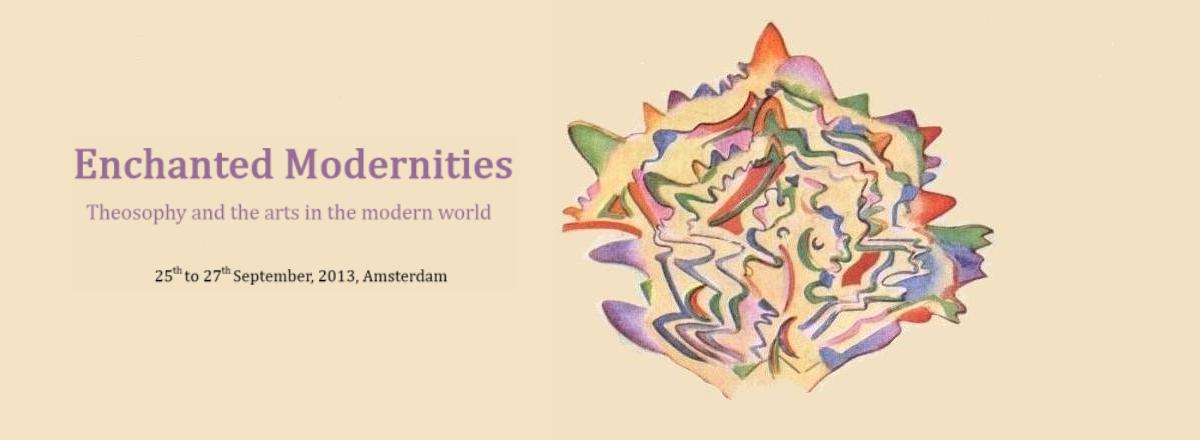
Enchanted Modernities: A conference in Amsterdam
An exciting three-day conference opened its doors in Amsterdam this morning (September 25, 2013). Enchanted Modernities: Theosophy and the Arts in the Modern World is the first conference of a new research network coordinated from the University of York and sponsored by the Leverhulme Trust. The conference in Amsterdam is hosted by the Center for History of Hermetic Philosophy and Related Currents, with the collaboration of the Ritman Library and the Theosophical Library – both places hosting exhibitions as part of the programme.
The focus of the conference is on Theosophy and art – not an unfamiliar topic, of course, but one which is now starting to see more systematic and interdisciplinary attention. From the conference website:
“2045, Rapture of the Nerds!” A public lecture in Trondheim, Norway
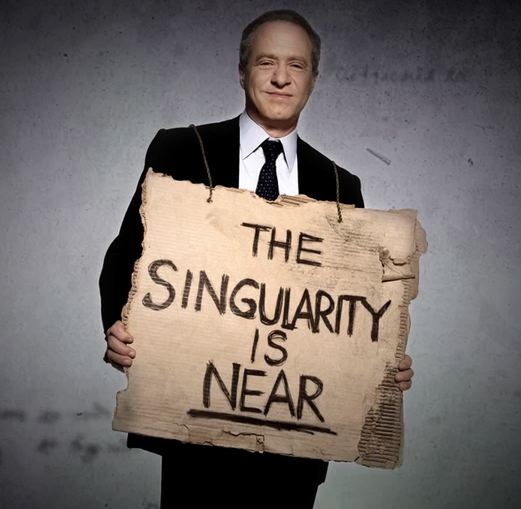 If you’re in Trondheim next week, I am giving a public lecture on some aspects of the transhumanist movement. It’s organized by the excellent club- and lecture initiative Forum Nidarosiae. The lecture will be in Norwegian, but I attach an English translation of title and blurb below:
Jakob Böhme Crash Course – BPH/HHP Webinar
There is another webinar out from the collaboration between the BPH and the HHP in Amsterdam. This time, Wouter Hanegraaff gives a one-hour crash course on the wonderfully obscure and fascinating German Silesian Christian theosophist/mystic/pietist (or however one wants to label him) Jakob Böhme (1575-1624). This cobbler from Görlitz was the author of some fairly heterodox theological texts, written in unsystematic, poetic, highly symbolic and mythologizing style. In this webinar, Hanegraaff focuses mostly on Böhme’s cosmogony – or rather, his theogony. In stark contrast to Christian orthodoxy, Böhme held that God was not eternal nor really transcendent, and certainly not immaterial or purely “spiritual”. To the contrary, he was obsessed with “the birth of God” from an original, primeval, unknowable chaos, the Ungrund (“un-ground”). Materiality and corporeality are always highlighted.




 Heterodoxology