A violent turn in 2012 apocalypticism

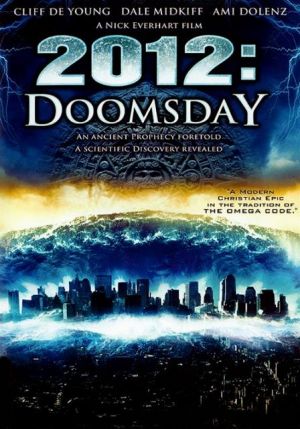
2012: Doomsday (2008) – another forgettable film in a cultural imaginary that is closing in on its final doom.

Finally it has happened: the first report of a 2012-apocalypse movement turning violent. The so-called “2012 phenomenon”, an occultural apocalyptic mythology with roots in the psychedelic gnosis of Terrence McKenna, the New Age prophesies of José Argüelles, and creative fringe-archaeological interpretations of the Maya “Long Count” calendar, has for the most part been oriented towards peaceful prophecies of a “global change in consciousness” or a “massive awakening”. But with countless improvisations on the theme by UFO-logists, conspiracy theorists, survivalists, and other denizens of the  darker segments of occulture, grimmer visions are hardly difficult to come by. Often enough, the boundaries between “positive”  expectations of global consciousness change (or the messianic arrival of friendly ETs) and the “negative” expectation of polar shifts, massive geological destruction, or the final enslavement of humanity by evil aliens, is not that easy to draw. What happens if the promised change for the better does not occur? What are the strategies of rationalizing such an (after all, realistically anticipated) theodicy? Could it be that the evil aliens are already here, and always were, working  in secret with the Illuminati, the Freemasons, the Bilderbergers and the world’s shadow governments to thwart the promised salvation?

(more…)

More esotericism at the Religious Studies Project: reflections on discursive (and other) methodologies

“Esotericism” – strange shapes and sights.

Just a couple of days after the Religious Studies Project posted a podcast interview with Wouter Hanegraaff on the academic study of esotericism, there is a follow-up in the form of a short-length essay, debating the possibilities and challenges of esotericism research. Its author, Damon Lycourinos, a current PhD candidate at the University of Edinburgh,  brings up a number of concerns – related to questions of European cultural identities (e.g. “reason” vs. “faith”), “the West”, definitional problems related to emic self-designations and typological constructs, etc.

(more…)

Wouter Hanegraaff was interviewed by the Religious Studies Project in Stockholm this August, on the topic of what the field “Western esotericism” is all about and where it is currently going. Since Sarah already did a good job (re)-introducing it at Invocatio, I’m simply going to reblog her post here. Do check it out – it’s a crash-course introduction to what the academic study of esotericism is about, by a/the major authority in the field.

Published in: on October 23, 2012 at 7:52 am  Comments (4)  
Tags: ,

From the Amphitheatre of Eternal Wisdom: Peter Forshaw on Khunrath in BPH’s Infinite Fire Webinar

The Bibliotheca Philosophica Hermetica in Amsterdam has, as previously mentioned, gone through a transformation lately, now focusing increasingly on web-based solutions. As a part of this renewal, BPH launched a webinar series entitle  “Infinite Fire”, in which scholars of esotericism will give online lectures on chosen topics, making use of unique material that is available in the library itself.

The first of these lectures is now available. It is given by my colleague Peter Forshaw, an expert of esotericism in early modern intellectual history, and particularly of alchemy. In the lecture, Peter speaks about one of his favourite authors: Heinrich Khunrath (1560-1605). The BPH website blurb has more:

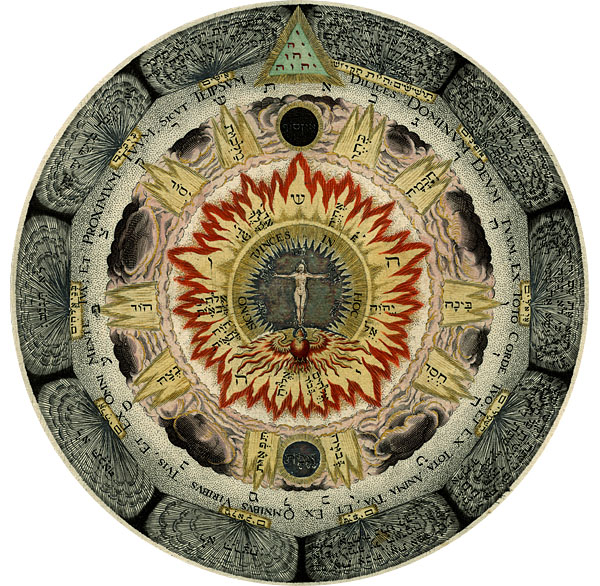
“In the webinar a focus is put on Khunrath’s Amphitheatrum Sapientiae Aeternae – The Amphitheatre of Eternal Wisdom (originally published in 1595), which has traditionally been considered to be a strange mix of Christianity and magic. Peter elaborates on the alchemical symbolism of 4 circular and 5 rectangular engravings integrated in the Amphitheatrum. A famous plate is the Tabula Smaragdina or The Emerald Tablet, to be considered one of the main inspirational works for alchemists, Hermetic philosophers and Rosicrucians. Aldous Huxley even mentions the Tablet contains an in-depth summary of what he calls the ‘Perennial Philosophy’, a timeless science of soul that keeps on surviving through the ages.”

Do check it out. Then wait until November, when Peter will be back with his second webinar lecture on Michael Maier’s Atalanta Fugiens.

Jesus was a … shaman (heterodox Christologies II)

Jesus the shaman

Jesus the shaman

Next up in what is quickly becoming a series on heterodox Christologies: Jesus was really a shaman. This claim was found in Norwegian media last week – more precisely in the Sami branch of the state channel NRK’s online news site. The (neo)shamanic healer Eirik Myrhaug went on record saying that he saw Jesus as “a great shaman”: “after all he was 40 days and 40 nights in the desert, and that’s a typical shamanic seance”.

This news item caught my attention because I have recently been working on an article on neoshamanism – or rather, on the genealogy and mythology of shamanism, as created by a motley crew of explorers, romantics, nationalists, psychedlelic gurus, anthropologists and historians since the 1600s – before it finally became a new religious movement in the 1960s. Myrhaug himself is of Sami descent, but his shamanic techniques appear to be derived from the anthropologist Michael Harner’s “core shamanism” – as is the case with the entire “revival” of shamanism in a Sami context. What struck me the most, however, was that Myrhaug’s shamanic interpretation of Jesus – which was heavily and predictably criticised by a Lutheran minister in the same news article – has a long history. “Jesus was a shaman” is in fact a stock element in the continuously expanding “universal shamanism” franchise.

(more…)

William Newman demonstrates alchemical transmutation – with a few notes on whiggishness

The perpetually mystified Newton

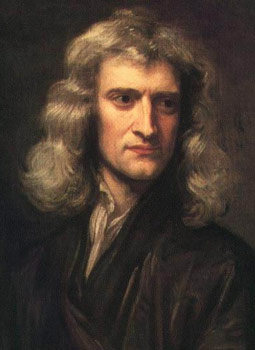
When I press the “publish” button for this post I shall immediately duck and take cover from allegations of whiggishness. The title of the lecture I post below, “Why did Newton believe in alchemy?” is precisely the sort of question-asking that has recently been criticised in the history of science blogging community in a recent upsurge of discussions about whig history and misapplication of categories in narrating or explaining science history. As Rebekah Higgitt wrote on teleskopos back in 2010, the “Newton as alchemist” trope seems to be a perennial surprise, and she suggested (I think convincingly) that the very fact that journalists but also scholars continue to introduce this topic precisely as a surprise – no doubt to attract the attention of their audience – is actually just perpetuating the mystery rather than leaving it behind and moving on. The problem is not only that we should start by acknowledging the state-of-the art established knowledge in the field (which in the case of Newton means at least departing from such works as Robert Westfall’s Never at Rest, and Betty Jo Teeter Dobbs’ The Janus Face of Genius) rather than by perpetuating the research questions of more than half a century ago. The problem is also that by playing the surprise card, we encourage people to ask questions that are poorly formulated and misleading in the first place. Questions such as, “was Newton a scientist or a sorcerer?” As Thony Christie will tell you, that’s a completely silly question, which cannot avoid distorting the material it’s supposed to clarify. To put it in histsci jargon, the question is too far removed from “actor’s categories” to make any sense.

(more…)

ContERN with its own website and blog

Heterodoxology has functioned as an unofficial outlet for ContERN news lately; for those who are not primarily interested in news about this obscure network, I apologize. Now, however, I can announce that the Contemporary Esotericism Research Network has finally gotten its own website and blog, which you can check out here. It’s relatively simple for now, but has the essential information about the fledgling network in a concise form. The blog section of the website will now work as a channel for announcing news (I might occasionally re-post here, too). The link section has references to important scholarly associations and societies, departments, and journals that are of relevance for the study of contemporary esotericism. These are obviously flexible lists, and will be modified as we go. Other pages will also be added to the website in the future, with new features and content, so stay tuned!

Published in: on October 5, 2012 at 10:32 am  Leave a Comment  
Tags:

Another review of the Contemporary Esotericism conference

There is another review up on the 1st International Conference on Contemporary Esotericism, written by Venetia Robertson and published by the Religious Studies Project (for earlier reviews, see this post). Venetia has found out about my secret identity as an agent of the cherubim (was it my flaming sword or my rosy cheeks that gave it away?), and for the rest has a lot of nice things to say about the conference that came out of this esthetic “marriage of heaven and hell”. I particularly think she’s spot on in referring to the  general atmosphere of the conference being  characterised by “tough love”.

Go read the whole thing. There’s also some revealing pictures from the Dragon Rouge temple, tucked away in an unassuming suburban apartment building in Stockholm.

Buy a book on werewolves and help Malört Förlag

The Werewolf in Swedish Folklore published by Malört Förlag (photo: Per Faxneld)

Malört Förlag (“Wormwood Publishing”) is a unique and delightful little Swedish publishing house “specializing in texts about the fantastic, the numinous and the aberrant”. Being in the trade of craft books, their editions are made to last for generations – and as if that does not already mark their releases from most books published these days, each new release also come with its own soundtrack. Thus you can read the first Swedish translation of Jacques Cazotte’s 1772 occult novel Le Diable Amoureux (The Devil in Love) while listening to tracks such as “I’m in Love With the Devil” (Tiger Lillies), “Mistress of Deceit” (Jarboe), and  “Love in the Devil’s Tongue” (Stone Breath). While Malört has so far been focusing on publications in Swedish, they do plan to expand to the English speaking market soon.

That is, if they are able to continue.

(more…)

Digitized sources for the history of German parapsychology

Sphinx journal

German occult, spiritualist and parapsychological journals now digitized and available online.

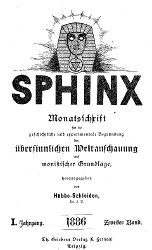
The history of parapsychology has been one of my research interests in recent years. It is not so long ago that I  reviewed Heather Wolffram’s recent book on German parapsychologyStepchildren of Science,  and noted that it breaks new ground in providing access to little-explored German sources – in English. Much of the source material for German parapsychology is indeed very hard to access outside of Germany. In my own research, I have been able to draw on a good collection of psychical research literature at the Amsterdam University Library, much of which was collected by a students society for psychical research active in Amsterdam in the early 20th century. Even this collection is weak on German sources, however. The same is true for the digital collections available through Archive.org – a great resource for anglophone sources, but less so for other languages. In my case, I had to spend a couple of days at the IGPP’s collections in Freiburg to finish the parts of my research that dealt with German parapsychology.

(more…)