The Problem of Disenchantment – invitation to a PhD defence

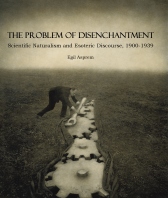
Problem of DIsenchantment cover

Last autumn I completed my PhD dissertation, and now it’s time to defend it. The defence is public, and will take place on February 5, 2013, at 12:00 in the Agnietenkapel of the University of Amsterdam. The event is open to anyone (with a max. capacity of 90 people), and I will give a short public lecture on the topic of my research prior to defending it in front of the committee.

While I have given hints about my research in a number of posts here at Heterodoxology, I am now happy to present an official abstract of the final product – the dissertation itself:

(more…)

Two conferences in June, 2013: CESNUR and ESSWE4

This June will be a busy conference month, as often is the case. This year, as last August (EASR and Contemporary Esotericism), Sweden is the place to be for big international events having to do with (“alternative”) religion and esotericism. Two big conferences are planned, and it is still possible to submit proposals for both of them – although not for very long. Below is the information you need.

(more…)

Published in: on January 7, 2013 at 1:16 pm  Leave a Comment  
Tags: ,

Scientific delusions, or delusions about science? (part two: Mechanism, life, and consciousness)

moses-and-the-ten-commandments

Do you know the meaning of dogmatic?

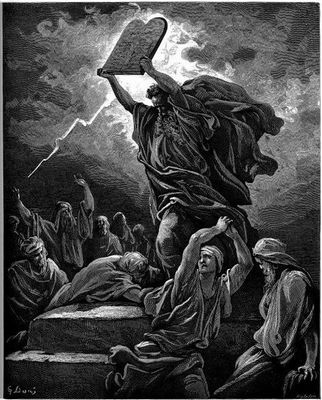
In the previous post on Rupert Sheldrake’s Science Delusion, I noted that the overall argument is based on a number of misrepresentations and stereotypes of what “science” is up to. The reader gets the impression of a monolithic structure, big-S-“Science”, now dominated by Ten Dogmas, like commandments cut in stone tablets. The history of science has, of course, been rather more complicated. Several of the dogmas do not even correspond well with the actual theories that are pursued today: at best they represent a pointed caricature,  at worst, they build on stereotypes crafted about a century or longer ago, that hardly have any relevance for contemporary scientific practice. Even to the extent that some of the “dogmas” refer to presently widespread theoretical or methodological conventions, holding these to be fixed dogmas obscures the fact that they are the outcome of long and sometimes complicated historical developments, both internal and external to science. In short: that is a widely held belief does not make a “dogma”; that is a commonly recommended way of pursuing a task does not make a dogmatic procedure.

As promised in the previous post, I will go through the ten dogmas one by one to demonstrate some of these points. In the present one we shall focus on the first two, which have to do with questions about mechanism, vitalism, scientific method, materialism, and the problems of defining “consciousness”. We will visit some historical backgrounds and parallels to Sheldrake’s criticism of science, and test his claim that science has closed certain questions “dogmatically”, by holding them up against the actual historical developments of some of the special sciences. Without further ado, here goes dogma #1:

(more…)

Scientific delusions, or delusions about science? Rupert Sheldrake’s ten dogmas (part one)

The Science Delusion (Coronet, 2012)

The Science Delusion (Coronet, 2012)

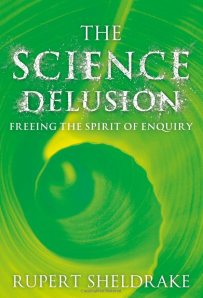
Rupert Sheldrake’s latest book, The Science Delusion (2012; Science Set Free in the US), has been given quite a lot of attention this year. Through its UK title, the book is clearly situated in the market as a sort of counter-manifesto to Dawkins’ God Delusion, or more precisely to the so-called “New Atheism’s” attempt to monopolize discourses on science for a wholly secular, atheistic, and anti-“magical” worldview. Sheldrake’s book has indeed worked as a sort of battle cry for a certain segment of the educated population left cold by creationists and new atheists alike, in fact a rather big group that wants to retain a worldview hospitable to irreducible mysteries without compromising their identity as modern, scientific-minded, rational people.

Sometimes, this rather precarious situation – of wanting science to be something else than what the scientists appear to make it – triggers a form of “ressentiment” against what is perceived as a dominating elite: “Materialist” elite scientists are exercising a “corrupting” influence across the fields of science. Had they not, everyone would have seen it our way. This sort of ressentiment is evident in much of Sheldrake’s polemic. There is much talk of “Science” as a gargantuan single entity, and what “it” dogmatically says and does. Perhaps that is what one would expect from someone who ditched a mainstream scientific career decades ago to pursue the elusive promises of parapsychology, while tirelessly expanding and pushing his own neo-vitalistic theories of “morphic resonance” and the “morphogenetic field” (rejected by his peers) in books and articles published for a wider and much more enthusiastic audience. His popular image as a persecuted visionary was greatly enhanced by the senior editor of Nature John Maddox, who foolishly entitled his review of Sheldrake’s A New Science of Life (1981)  “a book for burning?”. Commercially speaking, it was probably the best review Sheldrake could ever have hoped for.

(more…)

The discovery of esotericism in Italy in the 20th century – from the ContERN cyberproceedings

Benedetto Croce (1866-1952)

Benedetto Croce (1866-1952)

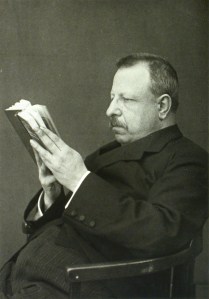
The latest addition to the cyberproceedings of August’s conference on contemporary esotericism is slightly different from previous installations in the series. It is not too contemporary, but it adds a discussion that should be quite interesting to anyone involved in the definition debate and the broader history of the academic study of esotericism. Francesco Baroni’s paper focuses on what one might call the  discovery of esotericism in Italy during the early-to-mid 20th century, by a generation of idealistically (in the philosophical sense) oriented scholars. Baroni shows how Benedetto Croce, Adolfo Omodeo and Piero Martinetti were all involved with uncovering esoteric aspects of e.g. Renaissance natural philosophy, early Christianity, and Western idealist philosophy, even while despising the “irrationalism” of modern and contemporary esoteric currents such as spiritualism and Theosophy.

(more…)

Michael Maier’s Atalanta Fugiens – a Webinar with Peter Forshaw

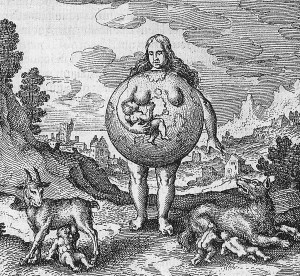
Atalanta_Fugiens_-_Emblem_2dEver wondered what those enigmatic emblems in Michael Maier’s Atalanta Fugiens (1617) are all about? Well, you could do much worse than watching  Peter Forshaw speak about it in the latest BPH webinar. Peter places Maier in the context of 16th and 17th century alchemy, emblematics, the Rosicrucian furore, early printing culture, and the broader political contexts of both continental Europe and England at the time. He also takes the time to go through a few of the 50 emblems in the book.

For the book itself, there is a transcription of an English translation of the original Latin available at the Levity website.

A tour of the BPH with its founder, Joost Ritman

In the spirit of its new policy of openness (“Hermetically open”), the Bibliotheca Philosophica Hermetica has posted a video on its YouTube channel that contains a 53-minute tour of the library’s collection, given by the founder Joost Ritman himself. This gives an excellent opportunity for non-Amsterdammers to have a peak at what the BPH looks like, and what the collection contains. But more than that, it gives an interesting insight into the mind of Ritman himself. As he guides online viewers through parts of his collection, we get to know quite a bit about how Ritman conceives of his collection, what it means to him, and what he has been trying to achieve with the library from the beginning. Worth checking out if you are curious about this legendary library and its founder.

“Correspondences” – Launching a new journal for esotericism research

The rumour already broke yesterday on Twitter and Facebook (a bit earlier than planned, I think), that a new journal is being launched: Correspondences: An Online Journal for the Academic Study of Western Esotericism.

This is an innovative initiative in several respects. By being all online and open access, it aims to provide “a wider forum of debate regarding issues and currents in Western esotericism than has previously been possible”. Furthermore, however, it also aims to mobilize a currently unused demographic potential in the study of esotericism:

Correspondences is committed to publishing work of a high academic standard as determined by a peer-review process, but does not require academic credentials as prerequisite for publication. Students and non-affiliated academics are encouraged to join established scholars in submitting insightful, well-researched articles that offer new ideas, positions, or information to the field.

In other words, it is a refreshing initiative that aims to be true to some of the most basic ideals of academic/scientific scholarship: that knowledge is available to everyone (thus must also be free), and that it is produced by a rigid application of “organized scepticism”, a communal, critical practice that is embodied by the peer-review process and otherwise blind to social, institutional, geographic, or political background. (Yes, I am echoing old Merton’s CUDOS here). In the the field of esotericism, I think these are very good norms to hold on to, and I am hopeful that this journal may establish itself as a nice and fresh competitor to already existing journals (e.g. Aries), catering to a somewhat different, expanded demographic, and allowing for a much more flexible and up-to-date exchange by being web-based, open, and free.

(more…)

W. J. Hanegraaff on Arguing with Angels

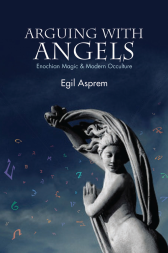
Wouter Hanegraaff has typed up a nice little review of my book, Arguing with Angels, over at his Creative Reading blog. He has many kind words, but I am first of all pleased that there are some very good observations about what I attempted to achieve in it: first to expel some common myths in the historiography of Dee reception, and secondly to highlight the “authenticity problem” struggled with in modern and contemporary ritual magic in general, and Enochian magic in particular. Wouter’s observations even point out wider connections that I did not explore explicitly in the book – namely that the authenticity dilemma finds similar responses in Western religious history more broadly, as prototypically expressed in the camps variously emphasising  scripture, tradition, or personal experience during and following the Christian Reformation. (Incidentally, I recently explored these themes in an article on (neo)shamanism that is still to appear in a Norwegian journal – that one, in turn, influenced by Wouter’s own work. The non-vicious, beneficent spirals  of academia.)

(more…)

PhD opportunities in Amsterdam (deadline February 2013)

Some readers of this blog may be interested to know that there are currently PhD vacancies at the University of Amsterdam, in the Institute for Culture and History (ICG). These are not in the “History of Hermetic Philosophy and Related Currents“-subdepartment (GHF) per se (we just appointed two new candidates for our regular positions);  instead they are open vacancies in the humanities, meaning that the best research proposals will be employed for a period of 3-4 years. It would nevertheless be a good opportunity for anyone hoping to do a PhD on an esotericism-related subject. Or any other subject in the humanities, for that matter: Amsterdam really is a nice place to do your PhD, in a vibrant international environment, and with a decent salary on top of that. (The latter really matters in a day and age where people go into heavy debt only to find a status as “overqualified” and “unemployable” on the other side of the PhD defence.)

Deadline is February 1. Find guidelines and details on how to apply here.

Published in: on November 19, 2012 at 1:55 pm  Comments (1)  
Tags: , , ,