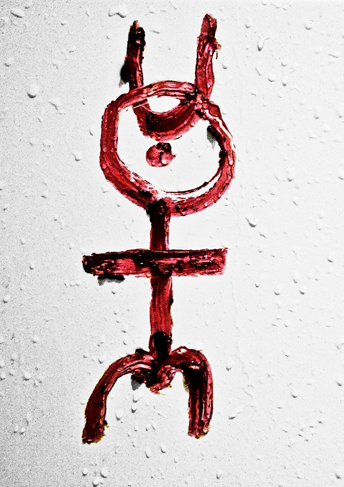
 As advertised before, there will be a book out next year on Contemporary Esotericism, edited by Kennet Granholm and myself. The volume brings together well-established and up-and-coming scholars in the field of esotericism, with brand-new research articles on contemporary esoteric topics. In connection with the book, we are organising an international conference on the same topic, to be held at Stockholm University next August. Below you will find the full call for papers. You can also check out the conference website. It’s early, but we will accept proposals as soon as they start coming in, so no need to postpone thinking about it.
International Conference on Contemporary Esotericism: Call for Papers

On “Scientific Illuminism” and the Psychologisation of Magic
 There is a post up at the tyromanteia blog, which offers a nice criticism of my article on Aleister Crowley’s negotiation of magic with science and psychology (“Magic Naturalized?”, published in Aries back in 2008). Tyromanteia draws on the work of Alex Owen (which I briefly reviewed last year) to place three 20th century magicians, Crowley, Israel Regardie, and Dion Fortune, within a broader “crisis of subjectivity” and a process of psychologisation. In this connection, the author finds opportunity to deal with my criticism of the “psychologisation thesis” on the survival of magic. I largely performed this criticism on the basis of Crowley, arguing that in this case, an attempted naturalisation of magic is more important than psychologisation. To this, Tyromanteia objects that Crowley largely anticipated the psychological and even psychotherapeutic interpretations which Regardie and Fortune later emphasised in their teachings. As I think this criticism points out an ambiguity in the original article, I will take this opportunity to make a brief response.
Aries 11.1
 Heterodoxology has aimed to establish the practice of reviewing new publications and releases in the field of esotericism, particularly notifying about current issues of the journal Aries. Aries 11.1 has been out for a couple of months already, so this comes somewhat late.
Blind Spots of Disenchantment (2/3)
Following up the previous post about Weber’s notion of disenchantment, and its normative implications, this second part of the installment provides some snapshots of episodes in the early 20th century – that is, of Weber’s contemporaries – which all seem to be in conflict with the disenchanted perspective of science. We start by considering some episodes in physics, then move on to the life sciences, before ending with some remarks on the controversial borderland which is psychical research.
Blind Spots of Disenchantment (1/3)
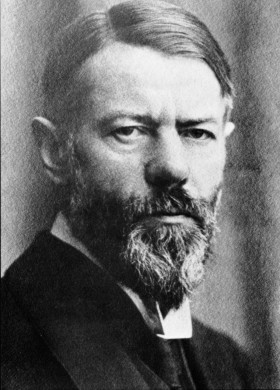
Max Weber (1864-1920)
The way things have turned out, the content of my PhD dissertation will revolve around a concept which Max Weber somewhat unsystematically formulated almost 100 years ago: the disenchantment of the world. Disenchantment has usually been described as a socio-cultural process, driven by rationalisation and intellectualisation processes which Weber traced back to the invention of monotheism, and the development of monotheistic theology. It has been embraced by sociologists and historians of religion in particular, who have seen in it (as did Weber) certain consequences for the condition of religion, magic, and their relation to intellectual life (and particularly science) in the modern world. My dissertation is increasingly becoming a criticism of the concept of disenchantment, and an exploration of a more nuanced approach to it as it relates to interfaces between religion, science, and that vast unsystematic and poorly defined set of “the occult”, “esoteric”, and “magical”. In April I had two opportunities to discuss these ideas in workshop settings, first with a commentary from the social historian of knowledge Peter Burke, and later in a research workshop for cultural history PhDs in the Netherlands called the Barchem symposium. In this post, and in two following installments, I will share the text of my lecture(s), intended to give an overview of my general approach, illustrated with snapshots of relevant cases from early 20th century history of science and culture. This first post discusses, historicises and criticises Weber’s concept of disenchantment in what is a brief theoretical introduction proposing that we take a different approach to it. Part two will concern the place of this revised notion in early 20th century scientific discourses, particularly in their broader cultural reception and context. The third part discusses briefly the attempt to create a “new natural theology” in this period.
Contemporary Esotericism – a pre-production advertisement
 One of the reasons for not writing here very often this spring is that I am co-editing a major volume in my “spare time”. Last week I visited my good friend, colleague and co-editor Kennet Granholm at Stockholm University, to discuss some final issues. This weekend, we ship the manuscript off to Equinox Publishing – a full 689 pages – ending a period with much editorial work. To celebrate this, I’ll kick off some pre-production advertising of the volume, which bears the title Contemporary Esotericism.
Peter Burke, the social history of knowledge, and “agnotology” – notes on a lecture
 It’s been a busy spring so far, and unfortunately not much time for keeping this blog running. In an attempt to get started again I will give a brief report on Professor Peter Burke’s visit to Amsterdam last week, and particularly one lecture (out of two) he gave on that occasion.
Errata, and a lesson of caution for “culturomics”
In the previous post I shared my enthusiasm about possible applications for digital, quantitative tools for studying historical data. Focusing on how Google’s N-gram Viewer may lead to interesting findings in the field of esotericism, both in order to gauge trends in popularity or spread of a certain term (such as “esotericism” itself) in various languages, and in order to research philological matters. In the latter case, one of the preliminary results seemed much more like a breakthrough at first sight than it really appears to have been. In fact, now instead we have an illustration of a serious difficulty with this kind of research, which emphasises the necessity of the critically-minded, suspicious human scholar in the middle of all digital tools.
Quantitative heterodoxology
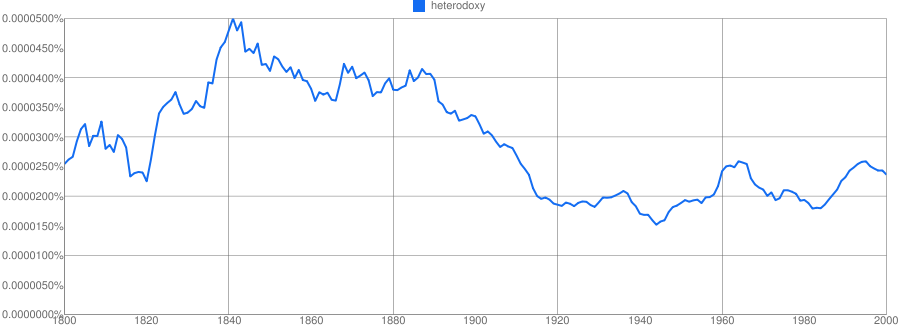 Last week Science published an article introducing the term “culturomics” – the quantitative study of cultural trends. By constructing a database out of the by now 15 million books that Google have digitized over the past years, a Harvard based research team led by Jean-Baptiste Michel have created a powerful searchable tool which makes it possible to create quantitative date for analysing cultural trends. As they state in the abstract:
We constructed a corpus of digitized texts containing about 4% of all books ever printed. Analysis of this corpus enables us to investigate cultural trends quantitatively. We survey the vast terrain of ‘culturomics,’ focusing on linguistic and cultural phenomena that were reflected in the English language between 1800 and 2000. We show how this approach can provide insights about fields as diverse as lexicography, the evolution of grammar, collective memory, the adoption of technology, the pursuit of fame, censorship, and historical epidemiology. Culturomics extends the boundaries of rigorous quantitative inquiry to a wide array of new phenomena spanning the social sciences and the humanities.
In short, this is a tool which has the potential to revolutionise research methods in a vast number of fields. The best part: Google Labs have made the tool (the Ngram viewer) publicly available. Before even starting reading the article I found myself thinking about a number of applications for my own research and field. Below follow some rough examples, and preliminary results which already seem to challenge established knowledge in the history of esotericism.
“Emic historiography of science” – a possibly useful term
 It’s been silent here for a while. My excuse is a lot of traveling and lecturing over the past month. In trying to get back to blogging, I’ll give some thoughts on a concept I’ve been thinking about in connection with one of the lectures in Trondheim a few weeks ago: “emic historiography of science”.





 Heterodoxology