Nazi-occultism on the ContERN website

Floor mosaic from Wewelsburg castle – from decorative item to occult world domination…

Next up in the cyberproceedings from the Contemporary Esotericism conference is a paper by Eva Kingsepp on Nazi/SS occultism, the changing perceptions of it in “official memory culture”, and its reception and influence on contemporary occulture. The primary focus is on the heavily mythologized symbol of the “Black Sun”, and the SS’  Wewelsburg castle, alleged to be the magical centre of the Third Reich,  where Heinrich Himmler gathered his SS “knights” and performed sinister rituals under the occult sign of the Black Sun.

Or not. As Kingsepp shows, myths of this kind have by now been properly debunked by real historiography. That, however, does not diminish the effect of the Nazi-occult mythology in popular culture and occulture.

From the introduction:

The aim of this paper is twofold, both related to the uses of history. The first concerns the basic assumptions about Nazi occultism as a phenomenon in itself. -What are the discursive relations between official memory culture and popular culture regarding Nazi occultism? The second is to look at the Temple of Set, more specifically its Order of the Trapezoid, as an example of how an esoteric group relates to Nazi occultism and puts this, as it is being conceived by leading members of the Order, into magical use. -From where do practicing occultists working with elements from National Socialism get the theoretical basis for what might be called their magical ideology

Go read the whole thing here.

Cyberproceedings from the Contemporary Esotericism conference

The ContERN website is slowly becoming active. Today we have published the first papers of the cyberproceedings from the Contemporary Esotericism conference in Stockholm this August. The first four papers to appear include two on Freemasonry and initiatic societies (J. Scott Kenney and Aslak Rostad), one on methodological issues in the study of contemporary Satanism (Jesper Aa. Petersen), and one on occulture in Brazilian pop music (Francisco Santos Silva). All of them should offer a lot of food for thought, so I suggest you go check them out: Is fraternalism a form of “moral elitism”? How do Masons experience the influence of joining the craft on the direction of their  lives? How are we to draw boundaries between different types of “Satanism“? And what does Aleister Crowley have to do with Brazilian pop music of the 1970s? Read and find out.

Arguing with Angels in paperback

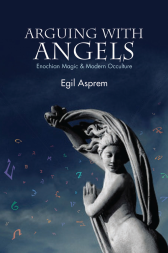
Arguing with Angels book cover

Arguing with Angels – now in paperback

My first book, Arguing with Angels: Enochian Magic and Modern Occulture, is about to be released in paperback. This means that one can finally get it at a more reasonable price: $24,95.  The paperback is officially released by the publisher on January 1, so just a little too late for a Christmas present, but it can already be pre-ordered from the SUNY website.

For more information about the book, with links to  reviews and discussions online, go here.

Hermetic feminism revisited

Yesterday I recommended Joyce Pijnenburg’s excellent discussion of Cornelius Agrippa and the Hermetic/Platonic/Kabbalistic influence on Renaissance feminism. Today, Sarah Veale of Invocatio added some reflections on what the ancient hermetic sources actually have to say about women. The argument is that the Hermetica had to be read rather selectively for Agrippa to find support for his proto-feminist project. In other words: here, as elsewhere, we must clearly separate the Hermetica from the hermeticists of the Renaissance. This point, of course, is always valid when we are dealing with reception, particularly in the case of normative projects in religion or philosophy. It’s little use  reading the gospels alone if one wants to  find out what various Christian denominations of today actually preach. And it’s foolish to expect contemporary ethicists who (sometimes) identify as neo-Aristotelians (say, Martha Nussbaum) to buy every detail of Aristotle’s doctrines of the soul, or indeed his views on women.

At any rate – nice to see a discussion taking shape online on esoterica and feminism, which is generally a very little studied topic.

Cornelius Agrippa and Renaissance feminism at the BPH blog

H. C. Agrippa – occult, sceptical, and feminist philosopher of the Renaissance.

The BPH/Ritman Library’s blog has an article-length post up by my good friend and colleague Joyce Pijnenburg, on the Renaissance humanist and “occult philosopher” Heinrich Cornelius Agrippa and his lesser known treatise on the nobility  of women. I remember being fascinated by this work when I first “discovered” Agrippa in my late teens – back then it was an eye-opener for me to find that the man who had been embraced by modern occultists as “their” intellectual patron, primarily for his Three books of occult philosophy (and the spuriously attributed Fourth book), had also produced works of sceptical philosophy (De incertitudine et vanitate scientiarum et artium), as well as a work that might classify as “Renaissance proto-feminism”. Agrippa is certainly more interesting than he’s often made into.

Joyce takes a closer look at this little-explored Renaissance feminist current, and transposes it  with certain contemporary issues discussed by Slavoj Žižek (whom, I must confess, I generally see as a stand-up comedian rather than a philosopher – some sharp observations, much hyperbole, and a lot of hilarity). The article  is entitled “Does woman exist? Agrippa von Nettesheim and Slavoy Žižek on Women and (their) Presence”. As an additional teaser before you go and read the whole thing, here’s the abstract:

(more…)

A violent turn in 2012 apocalypticism

2012: Doomsday (2008) – another forgettable film in a cultural imaginary that is closing in on its final doom.

Finally it has happened: the first report of a 2012-apocalypse movement turning violent. The so-called “2012 phenomenon”, an occultural apocalyptic mythology with roots in the psychedelic gnosis of Terrence McKenna, the New Age prophesies of José Argüelles, and creative fringe-archaeological interpretations of the Maya “Long Count” calendar, has for the most part been oriented towards peaceful prophecies of a “global change in consciousness” or a “massive awakening”. But with countless improvisations on the theme by UFO-logists, conspiracy theorists, survivalists, and other denizens of the  darker segments of occulture, grimmer visions are hardly difficult to come by. Often enough, the boundaries between “positive”  expectations of global consciousness change (or the messianic arrival of friendly ETs) and the “negative” expectation of polar shifts, massive geological destruction, or the final enslavement of humanity by evil aliens, is not that easy to draw. What happens if the promised change for the better does not occur? What are the strategies of rationalizing such an (after all, realistically anticipated) theodicy? Could it be that the evil aliens are already here, and always were, working  in secret with the Illuminati, the Freemasons, the Bilderbergers and the world’s shadow governments to thwart the promised salvation?

(more…)

More esotericism at the Religious Studies Project: reflections on discursive (and other) methodologies

“Esotericism” – strange shapes and sights.

Just a couple of days after the Religious Studies Project posted a podcast interview with Wouter Hanegraaff on the academic study of esotericism, there is a follow-up in the form of a short-length essay, debating the possibilities and challenges of esotericism research. Its author, Damon Lycourinos, a current PhD candidate at the University of Edinburgh,  brings up a number of concerns – related to questions of European cultural identities (e.g. “reason” vs. “faith”), “the West”, definitional problems related to emic self-designations and typological constructs, etc.

(more…)

Wouter Hanegraaff was interviewed by the Religious Studies Project in Stockholm this August, on the topic of what the field “Western esotericism” is all about and where it is currently going. Since Sarah already did a good job (re)-introducing it at Invocatio, I’m simply going to reblog her post here. Do check it out – it’s a crash-course introduction to what the academic study of esotericism is about, by a/the major authority in the field.

Published in: on October 23, 2012 at 7:52 am  Comments (4)  
Tags: ,

From the Amphitheatre of Eternal Wisdom: Peter Forshaw on Khunrath in BPH’s Infinite Fire Webinar

The Bibliotheca Philosophica Hermetica in Amsterdam has, as previously mentioned, gone through a transformation lately, now focusing increasingly on web-based solutions. As a part of this renewal, BPH launched a webinar series entitle  “Infinite Fire”, in which scholars of esotericism will give online lectures on chosen topics, making use of unique material that is available in the library itself.

The first of these lectures is now available. It is given by my colleague Peter Forshaw, an expert of esotericism in early modern intellectual history, and particularly of alchemy. In the lecture, Peter speaks about one of his favourite authors: Heinrich Khunrath (1560-1605). The BPH website blurb has more:

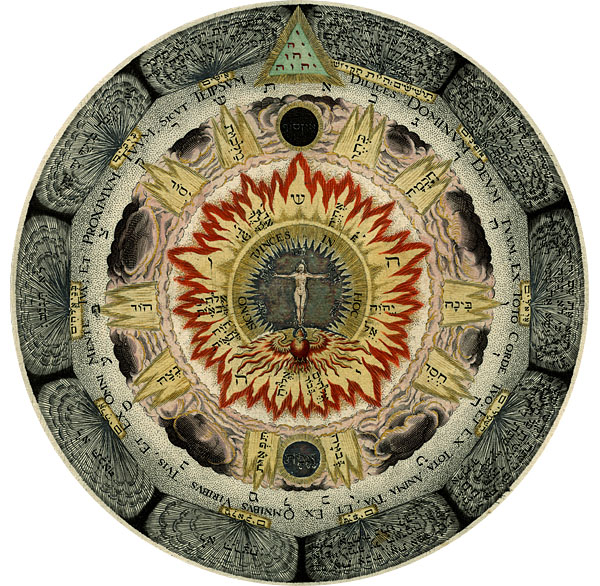
“In the webinar a focus is put on Khunrath’s Amphitheatrum Sapientiae Aeternae – The Amphitheatre of Eternal Wisdom (originally published in 1595), which has traditionally been considered to be a strange mix of Christianity and magic. Peter elaborates on the alchemical symbolism of 4 circular and 5 rectangular engravings integrated in the Amphitheatrum. A famous plate is the Tabula Smaragdina or The Emerald Tablet, to be considered one of the main inspirational works for alchemists, Hermetic philosophers and Rosicrucians. Aldous Huxley even mentions the Tablet contains an in-depth summary of what he calls the ‘Perennial Philosophy’, a timeless science of soul that keeps on surviving through the ages.”

Do check it out. Then wait until November, when Peter will be back with his second webinar lecture on Michael Maier’s Atalanta Fugiens.

Jesus was a … shaman (heterodox Christologies II)

Jesus the shaman

Jesus the shaman

Next up in what is quickly becoming a series on heterodox Christologies: Jesus was really a shaman. This claim was found in Norwegian media last week – more precisely in the Sami branch of the state channel NRK’s online news site. The (neo)shamanic healer Eirik Myrhaug went on record saying that he saw Jesus as “a great shaman”: “after all he was 40 days and 40 nights in the desert, and that’s a typical shamanic seance”.

This news item caught my attention because I have recently been working on an article on neoshamanism – or rather, on the genealogy and mythology of shamanism, as created by a motley crew of explorers, romantics, nationalists, psychedlelic gurus, anthropologists and historians since the 1600s – before it finally became a new religious movement in the 1960s. Myrhaug himself is of Sami descent, but his shamanic techniques appear to be derived from the anthropologist Michael Harner’s “core shamanism” – as is the case with the entire “revival” of shamanism in a Sami context. What struck me the most, however, was that Myrhaug’s shamanic interpretation of Jesus – which was heavily and predictably criticised by a Lutheran minister in the same news article – has a long history. “Jesus was a shaman” is in fact a stock element in the continuously expanding “universal shamanism” franchise.

(more…)