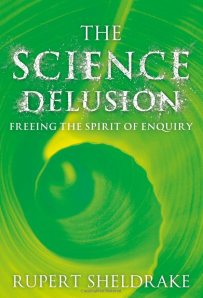
The Science Delusion (Coronet, 2012)
Rupert Sheldrake’s latest book, The Science Delusion (2012; Science Set Free in the US), has been given quite a lot of attention this year. Through its UK title, the book is clearly situated in the market as a sort of counter-manifesto to Dawkins’ God Delusion, or more precisely to the so-called “New Atheism’s” attempt to monopolize discourses on science for a wholly secular, atheistic, and anti-“magical” worldview. Sheldrake’s book has indeed worked as a sort of battle cry for a certain segment of the educated population left cold by creationists and new atheists alike, in fact a rather big group that wants to retain a worldview hospitable to irreducible mysteries without compromising their identity as modern, scientific-minded, rational people.
Sometimes, this rather precarious situation – of wanting science to be something else than what the scientists appear to make it – triggers a form of “ressentiment” against what is perceived as a dominating elite: “Materialist” elite scientists are exercising a “corrupting” influence across the fields of science. Had they not, everyone would have seen it our way. This sort of ressentiment is evident in much of Sheldrake’s polemic. There is much talk of “Science” as a gargantuan single entity, and what “it” dogmatically says and does. Perhaps that is what one would expect from someone who ditched a mainstream scientific career decades ago to pursue the elusive promises of parapsychology, while tirelessly expanding and pushing his own neo-vitalistic theories of “morphic resonance” and the “morphogenetic field” (rejected by his peers) in books and articles published for a wider and much more enthusiastic audience. His popular image as a persecuted visionary was greatly enhanced by the senior editor of Nature John Maddox, who foolishly entitled his review of Sheldrake’s A New Science of Life (1981) “a book for burning?”. Commercially speaking, it was probably the best review Sheldrake could ever have hoped for.






 Heterodoxology