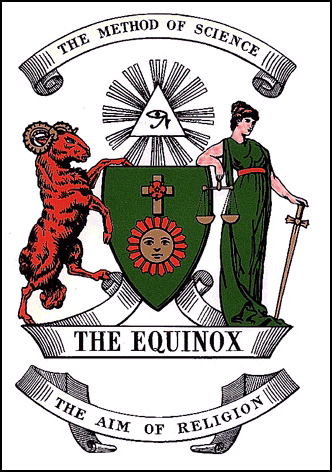
 There is a post up at the tyromanteia blog, which offers a nice criticism of my article on Aleister Crowley’s negotiation of magic with science and psychology (“Magic Naturalized?”, published in Aries back in 2008). Tyromanteia draws on the work of Alex Owen (which I briefly reviewed last year) to place three 20th century magicians, Crowley, Israel Regardie, and Dion Fortune, within a broader “crisis of subjectivity” and a process of psychologisation. In this connection, the author finds opportunity to deal with my criticism of the “psychologisation thesis” on the survival of magic. I largely performed this criticism on the basis of Crowley, arguing that in this case, an attempted naturalisation of magic is more important than psychologisation. To this, Tyromanteia objects that Crowley largely anticipated the psychological and even psychotherapeutic interpretations which Regardie and Fortune later emphasised in their teachings. As I think this criticism points out an ambiguity in the original article, I will take this opportunity to make a brief response.
On “Scientific Illuminism” and the Psychologisation of Magic

Arguing with Angels – another book you should get next year
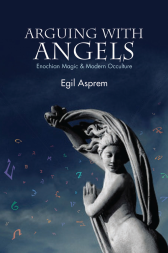
 A bit of shameless self-promotion: A pre-production description has recently been released by State University of New York Press, announcing the publication of my first book, Arguing with Angels: Enochian Magic and Modern Occulture. It is due in May 2012. As SUNY’s summary states, the book is an exploration of the Elizabethan philosopher John Dee’s system of angel magic, but in particular its reception history and various reinterpretations in modern times. It follows the creation of what is usually known as “Enochian magic”. Since 19th century occultism, and continuing in 20th century and contemporary occulture, this system has been understood in a variety of ways as it has become embedded in a number of different occult currents and practices.
The book pays special attention to the discussions and quarrels among occultist groups and practitioners over the “right” interpretation, and discusses the various claims that are made to legitimise such positions – vis-a-vis competing occultist interpretations on the one hand, and a generally perceived “disenchanted” modern society on the other. Among the main protagonists we find the Hermetic Order of the Golden Dawn, Aleister Crowley, Israel Regardie, Paul Foster Case, Anton LaVey and the Church of Satan, Michael Aquino and the Temple of Set, the obscure Order of the Cubic Stone, the Aurum Solis, and scores of cyber-age ritual magicians, debating the nature of angels and magical ritual online.
The book will appear in the SUNY series on Western Esoteric Traditions, which has previously published such classics in the field as Antoine Faivre’s Access to Western Esotericism, Joscelyn Godwin’s Theosophical Enlightenment, and Wouter Hanegraaff’s New Age Religion and Western Culture. There is no cover art up yet (this should be in place soon, my editors say), but below is the full publisher’s description:
Terror in the Mind of Who? A response to Mark Juergensmeyer on Breivik’s Christianity (and much besides)
The question of whether or not, or in what sense, the 22/7 Oslo terrorist Anders Behring Breivik is a “Christian”, and to what extent his Christianity had anything to do with his motivations to kill, has stirred up some debate. In my first post on Breivik I referred to sociologist of religion Massimo Introvigne’s refutation of the “Christian Fundamentalist” label, a label that really makes very little sense. More recently, however, other scholars of religion have insisted on emphasising Breivik’s Christianity, although refraining from categorizing it as Fundamentalism. At the University of Chicago the well-known American historian of religion Martin E. Marty writes about Breivik the Protestant. Meanwhile, another American scholar of note, Mark Juergensmeyer, insists that we see Breivik as a “Christian terrorist”.
Fiction, Templars, and Terrorism
 Heresy Corner has a good post on the Templar theme in Anders Behring Breivik’s manifesto. It particularly discusses the author’s ambiguous claim that the whole thing is to be read as “fictional” (scare-quotes in the original). Opening the post with a quote from Umberto Eco’s Foucault’s Pendulum sets the right tone from the start:
“The lunatic is all idée fixe, and whatever he comes across confirms his lunacy. You can tell him by the liberties he takes with common sense, by his flashes of inspiration, and by the fact that sooner or later he brings up the Templars.”




 Heterodoxology