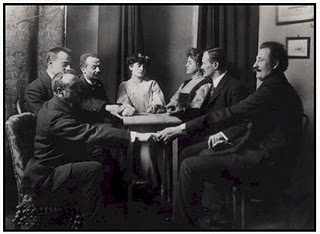
 Spiritualism was a symptomatic cultural trend of the Victorian period. For decades mediums captivated the worker, the bourgeois, the nobleman, the socialist utopian, the Christian apostate, and people from virtually any and all professions, with their table rappings, levitating furniture, full-form materializations, and messages from beyond the grave. When a message was coming through, whether from the ghost of Benjamin Franklin, the archangel Gabriel, or the sitter’s aunt Nelly, the spirit medium provided the goods. But despite this caricature, which no doubt does full justice to much of the movement, spiritualism also became a heated battleground for deeply natural-philosophic questions: what is Nature, how does she operate, and what can we know about her? Where are the boundaries of the natural to be drawn?
Naturalistic Spiritualisms

Goetia and Theurgy, magic black and white?
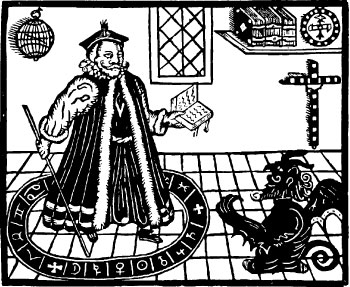
From Christopher Marlowe's Doctor Faustus
I was recently reminded of an article I was commissioned to write a long time ago. The topic is Goetia and modern western ritual magic. With the deadline approaching it is time to start brainstorming a bit. So be patient: rambling speech ahead!
Magic in the desert – and more misplaced psychologisms
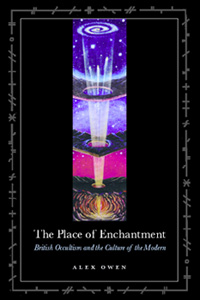 Aleister Crowley (1875-1947) is a hot name for heterodoxologists. He is also the most famous English occultist to have lived, his life having been told in about a dozen biographies. Today I taught a class on Crowley, magic, modernity and psychology, drawing on a chapter from Alex Owen’s book, The Place of Enchantment: British Occultism and the Culture of the Modern (2004).
Some notes on scientism
 The word “scientism” gets tossed around a lot in critical public debates about science’s place in society. Usually it is used derogatorily to dismiss a trend in using science which the user of the word doesn’t like. Used in this way, it is a rhetorical label without much analytic content. But it may also be turned into a useful category for analyzing historical data.
New Age televangelists?
In the very first blog post I noted in passing that contemporary media are more than happy to place a spotlight on heterodox religion and heterodox science. Well – in the latest issue of the Norwegian journal for culture- and religious studies, Din, there is an interesting article on alternative spirituality and television. Anne Kalvig focuses on the presence and function of alternative religiosity in Norwegian television media. What’s particularly interesting about it is her analysis of the sister TV channels, TV Norge and Kanal FEM as basing themselves on an “alternative-theological agenda”.
Galison in Utrecht
I just got home from Peter Galison’s first talk as Visiting Professor at Utrecht University. As advertised in a previous post, the lecture focused on the role of secrecy in modern science. Actually, the focus was a lot broader than that. Galison’s interest was to trace what he saw as some significant historical changes in the legitimization and enforcement of secrecy in western societies, roughly from the early 20th century until today. A significant part of his argument was that scientific discourse became subjected to secretive forms of political regulation from WWII onwards.
Positivism and the Religion of Humanity
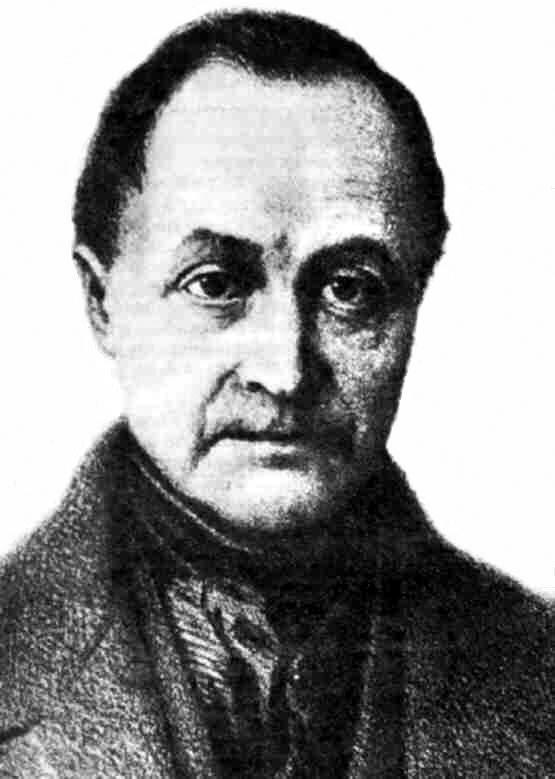 Auguste Comte (1798-1857) formulated some very influential ideas, and some ideas that were plain weird. The “father of sociology” argued for a full science of society, and invented the progressivist “Law of Three Stages”. By the 1840s Comte had founded the highly influential philosophy and ideology of Positivism. What next? He founded a Church and proclaimed himself High Priest.
Conference panel: Seduced by Science
 This has already been disseminated through other channels, but I’ll post it here anyway. My colleague Tessel Bauduin and I are organizing a panel at the next Quinquennial World Congress of the International Association for the History of Religions (IAHR). It’s in Toronto, it’s in August, and the title of the panel is “Seduced by Science: The culture of religion and science in the early 20th century”. We’re accepting paper proposals until April 15. See below for the details.
What’s “heterodoxy”, anyway?
It’s been a slow day at work. I might as well finish it off (and inaugurate the weekend) with sharing some simple reflections that are relevant for this blog: What the heck does “heterodox” mean, anyway?
Science and Secrecy in Utrecht
Next week one of the stars in the history of modern science visits Utrecht. Harvard Professor Peter Galison has written a number of highly acclaimed and original books, including How Experiments End (1987), Image and Logic (1997), and Einstein’s Clocks, Poincare’s Maps (2003). Between March 8-12 he will be delivering a series of lectures and workshops at the University of Utrecht. I will certainly be there.




 Heterodoxology